
Nearshore outsourcing helps businesses improve collaboration, reduce costs, and access skilled talent by working with teams in nearby countries.
It allows us to operate in the same time zone, communicate clearly, and maintain better control over projects. These advantages make nearshore outsourcing a practical solution for companies that want efficiency without complexity.
Keep reading to understand how it works and why it matters for long-term growth.
Core Benefits of Nearshore Outsourcing
Here are the most important benefits of nearshore outsourcing to understand before exploring the topic in more detail and practical context.
- Nearshore outsourcing improves collaboration through shared time zones and real-time communication
- Businesses can reduce costs while maintaining high-quality output and skilled talent access
- Geographic and cultural alignment leads to faster decisions and better project outcomes
What Is Nearshore Outsourcing and Why It Matters
Definition of Nearshore Outsourcing
Nearshore outsourcing means working with teams in nearby countries, usually within similar time zones, to handle business operations or technical tasks.
It sits between offshore and onshore outsourcing. Offshore involves distant countries with large time gaps, while onshore keeps everything local. Nearshore outsourcing offers a balance between cost savings and collaboration.
Why Businesses Are Shifting to Nearshore Models
Companies are shifting to nearshore outsourcing because modern operations require faster communication, better flexibility, and more reliable collaboration across distributed teams.
We need consistent communication and faster execution. Nearshore outsourcing helps us achieve these goals without delays caused by time differences or complex coordination.
Time Zone Alignment and Real-Time Collaboration
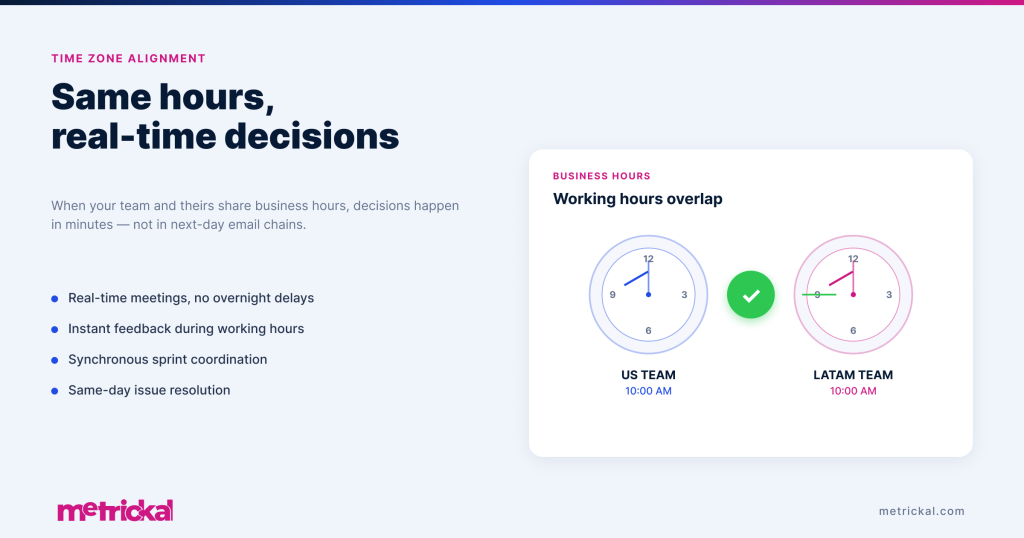
Alt text: Real-time collaboration across aligned time zones in nearshore outsourcing teams
Working in the Same Business Hours
Working in the same time zone allows teams to stay aligned during daily operations without delays caused by time differences or scheduling conflicts.
- No need for late-night or early-morning meetings
- Faster responses during working hours
- Better coordination across teams
This alignment helps us maintain steady workflows and reduce unnecessary delays in communication.
Real-Time Communication Benefits
Real-time communication allows teams to collaborate more effectively, especially when working on fast-moving projects that require constant updates and adjustments.
- Instant feedback between teams
- Faster decision-making processes
- Improved execution of agile workflows
We can solve problems faster because communication happens without waiting across time zones.
Geographic Proximity and Travel Advantages
Shorter Flight Times and Easier Travel
Geographic proximity makes travel easier and more practical, allowing teams to meet in person without complex logistics or high travel costs.
- Shorter flight durations
- Lower travel expenses
- Easier scheduling for visits
This makes it easier for us to maintain strong collaboration beyond digital communication.
Face-to-Face Meetings Made Simple
Face-to-face meetings remain important for building trust and aligning teams on goals, expectations, and project outcomes more effectively.
- Stronger relationships between teams
- Faster alignment on project goals
- Better problem-solving discussions
We can meet regularly without major disruption, which improves overall teamwork.
Cultural Compatibility and Communication Efficiency
Shared Professional Culture
Cultural alignment helps teams work together more smoothly by reducing misunderstandings and improving communication across different roles and responsibilities.
- Similar work ethics and expectations
- Familiar communication styles
- Shared understanding of deadlines
This makes collaboration more predictable and efficient for everyone involved.
Strong English Proficiency and Bilingual Workforce
Language clarity plays a key role in outsourcing success, especially when communication is required daily across teams and departments.
- Clear communication in English
- Reduced language barriers
- Better understanding of instructions
We can avoid confusion and ensure that tasks are completed correctly from the start.
Cost Savings Without Compromising Quality
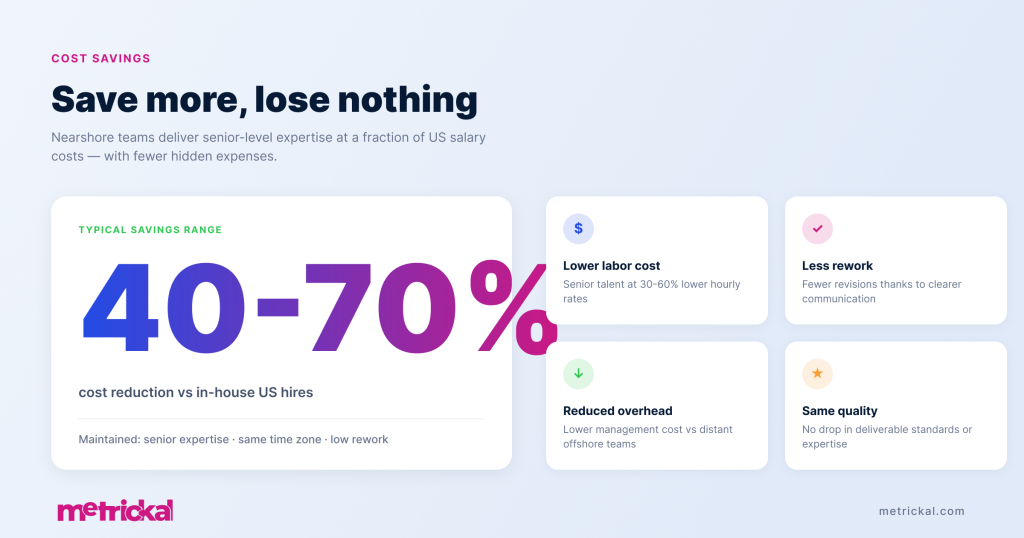
Alt text: Skilled nearshore talent team improving productivity and reducing outsourcing costs
Lower Labor Costs with High Skill Levels
Nearshore outsourcing allows businesses to reduce operational costs while still accessing skilled professionals with relevant experience and technical capabilities.
- Cost savings between 40% and 70%.
- Access to trained professionals
- Competitive salary structures
Understanding outsourcing cost structure explained helps us manage budgets more effectively and avoid unnecessary spending.
Reduced Hidden Costs
Hidden costs often impact outsourcing projects, especially when communication gaps or delays lead to repeated work and inefficiencies in execution.
- Fewer delays from miscommunication
- Reduced rework cycles
- Lower management overhead
We can maintain better financial control by reducing unexpected expenses.
Access to Skilled Talent Pools
Credit: Innovature BPO
Expanding Talent Availability
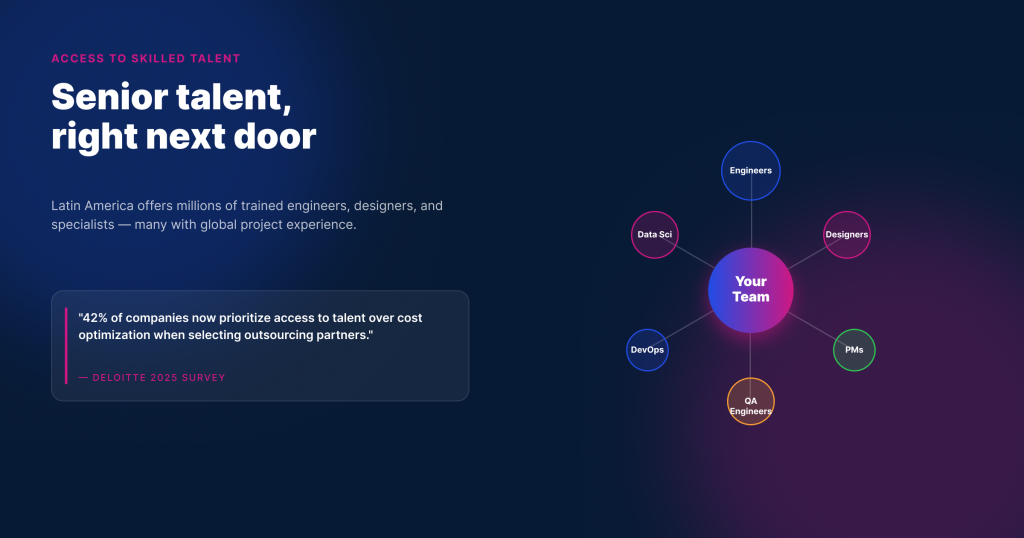
Nearshore outsourcing provides access to a large pool of professionals across different industries, allowing businesses to find the right talent quickly.
- Millions of available professionals
- Access to senior-level expertise
- Specialized skill sets
Access to skilled talent is a critical factor in building strong teams that meet specific project requirements in outsourcing strategies.
According to Deloitte, many organizations now prioritize talent quality over cost when selecting outsourcing partners, as highlighted in their research.
As reported by Deloitte, “42% of companies now prioritize access to talent over cost optimization when selecting their outsourcing partners.”
Regional Strengths
Certain regions are known for strong technical education systems and growing technology ecosystems that support skilled and experienced professionals.
- Strong engineering talent
- Modern technical training
- Experience in global projects
We benefit from professionals who understand international standards and expectations.
Faster Decision-Making and Agile Integration
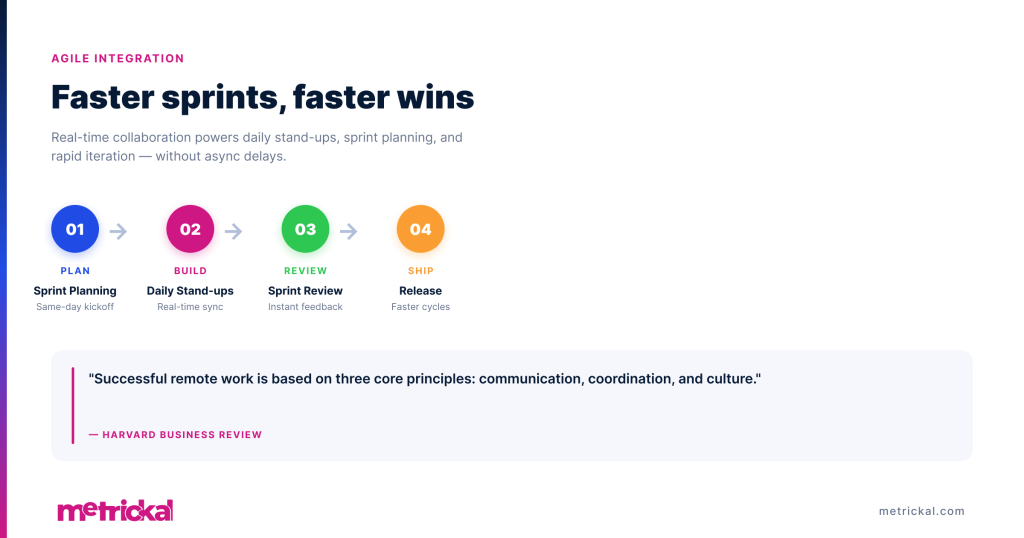
Seamless Agile Team Collaboration
Nearshore teams can easily integrate into agile workflows, allowing for consistent collaboration and faster progress across all project stages.
- Daily stand-ups without delays
- Real-time sprint collaboration
- Continuous communication
Nearshore outsourcing supports consistent progress by enabling real-time collaboration and faster decision-making across aligned teams and workflows.
Nearshore outsourcing supports consistent progress by enabling real-time collaboration and faster decision-making across aligned teams and workflows.
According to Harvard Business Review, effective remote and hybrid teams rely on strong communication and coordination to maintain productivity, as discussed here Harvard Business Review – Remote Collaboration Insights.
As noted in their analysis, “Successful remote work is based on three core principles: communication, coordination, and culture“.
Improved Productivity and Output
Better communication and alignment often lead to measurable improvements in productivity and overall team performance across projects and operations.
- Faster task completion
- Improved workflow efficiency
- Consistent output quality
We can achieve more in less time without sacrificing quality.
Enhanced Quality Control and Project Success Rates
Alt text: Glitched screenshot with overlapping UI elements and partial infographic showing “Growth & Velocity” and handshake illustration.
Better Oversight and Monitoring
Being closer in time and location allows businesses to monitor progress more closely and maintain consistent quality across all deliverables.
- Easier vendor management
- Frequent quality checks
- Clear visibility into work progress
We can stay involved without creating unnecessary complexity.
Reduced Rework and Higher Success Rates
Clear communication and better coordination reduce errors, leading to fewer revisions and more successful project outcomes over time.
- Fewer misunderstandings
- Faster issue resolution
- Higher success rates
We can deliver better results with fewer delays.
Regulatory Compliance and Data Security Alignment
Similar Legal and Compliance Frameworks
Nearshore regions often share similar legal frameworks, making it easier to comply with industry regulations and maintain operational consistency.
- Easier compliance management
- Familiar regulatory structures
- Reduced legal risks
We can operate with more confidence and stability.
Stronger Data Protection Practices
Data security remains a priority when working with external teams, especially when handling sensitive information and intellectual property.
- Easier IP protection
- Secure data handling
- Alignment with internal policies
We can protect critical information more effectively.
Scalability and Flexible Engagement Models
Predictable and Cost-Effective Scaling
Nearshore outsourcing allows businesses to scale teams up or down based on demand without long-term commitments or operational risks.
- Flexible team expansion
- Transparent pricing
- Cost-effective scaling
We can adapt resources based on changing needs.
Hybrid and Long-Term Collaboration Models
Different engagement models provide flexibility, allowing businesses to choose the structure that best fits their operational and strategic goals.
- Dedicated teams
- Staff augmentation
- Long-term partnerships
We can build sustainable working relationships over time.
Business Growth and ROI Advantages
Measurable ROI and Cost Control
Nearshore outsourcing provides clear financial benefits that can be tracked over time, helping businesses maintain control over spending and performance.
- Better cost control
- Improved financial planning
- Reduced operational risks
Outsourcing plays a key role in scaling operations, and understanding how outsourcing supports business growth helps us plan more effectively.
Faster Time-to-Market
Speed is critical in competitive markets, and nearshore outsourcing helps businesses deliver products and services more quickly.
- Faster development cycles
- Quicker product launches
- Better market responsiveness
We can stay competitive by moving faster.
Nearshore vs Offshore Outsourcing: Key Advantages
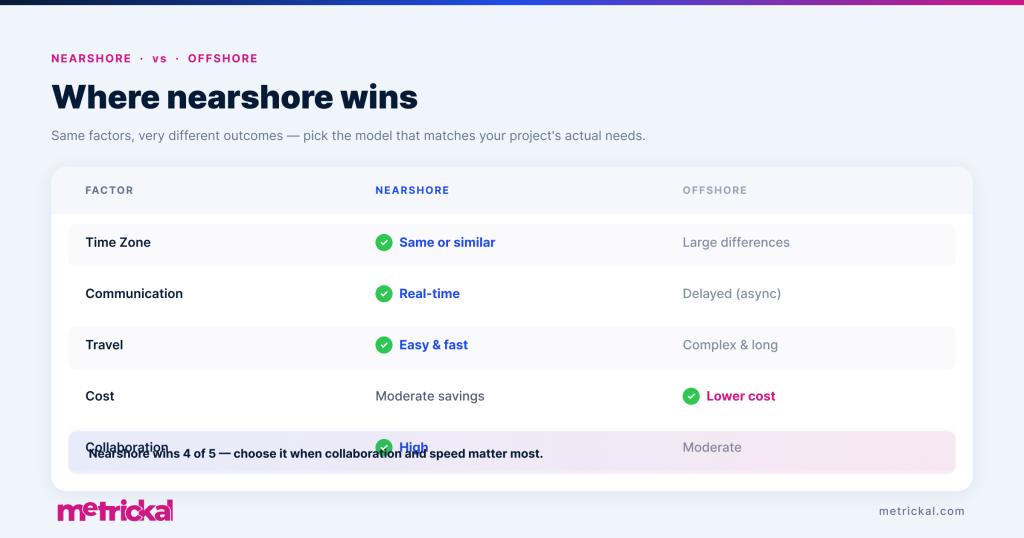
Key Differences Overview
Understanding the differences helps businesses choose the right outsourcing model based on their goals, timelines, and operational needs.
| Factor | Nearshore Outsourcing | Offshore Outsourcing |
| Time Zone | Similar or same | Large differences |
| Communication | Real-time | Delayed |
| Travel | Easy and fast | Complex and long |
| Cost | Moderate savings | Lower cost |
| Collaboration | High | Moderate |
A deeper look at nearshore outsourcing vs offshore comparison helps us understand which model fits specific project needs.
When Nearshore Is the Better Choice
Some projects require faster communication, stronger alignment, and better collaboration, making nearshore outsourcing the most suitable option.
- Real-time collaboration needed
- Complex or fast-moving projects
- Compliance-heavy industries
We can choose nearshore when efficiency and clarity are priorities.
Use Cases Across Industries
Software Development and IT Services
Nearshore outsourcing supports technology projects that require continuous collaboration and fast iteration cycles across development teams.
- Cloud migration projects
- Digital transformation initiatives
- Automation improvements
We can improve delivery speed and technical outcomes.
BPO, RPO, and Customer Support
Operational functions benefit from nearshore outsourcing, especially when consistent communication and service quality are required daily.
- Customer support operations
- Recruitment and hiring processes
- Back-office tasks
We can maintain efficiency and service quality at scale.
Industry-Specific Applications
Different industries use nearshore outsourcing to address specific challenges related to compliance, scalability, and operational efficiency.
- Financial operations
- Healthcare support
- E-commerce growth
We can adjust strategies based on industry needs.
FAQ
What are the main benefits of nearshore outsourcing?
Nearshore outsourcing offers key benefits such as real-time collaboration, cost savings, and access to skilled talent. It allows us to work within similar time zones, which improves communication and speeds up decision-making. This model also reduces delays and helps maintain better control over project quality and outcomes.
How does nearshore outsourcing improve communication?
Nearshore outsourcing improves communication by allowing teams to work in overlapping business hours. This makes it easier for us to hold meetings, provide feedback, and resolve issues quickly. With fewer time zone gaps and strong language proficiency, communication becomes clearer and more efficient.
Is nearshore outsourcing more cost-effective than offshore outsourcing?
Nearshore outsourcing can be cost-effective because it balances lower labor costs with higher efficiency. While offshore options may offer lower rates, nearshore reduces hidden costs like delays and rework. This helps us manage budgets better and achieve more consistent results over time.
What industries benefit the most from nearshore outsourcing?
Industries such as software development, customer support, fintech, and healthcare benefit from nearshore outsourcing. These sectors require strong communication, fast response times, and compliance alignment. Nearshore teams help us meet these needs while maintaining flexibility and scalability.
How do we choose the right nearshore outsourcing partner?
We choose the right partner by evaluating their experience, communication practices, and ability to align with our goals. It is important to assess their talent quality, scalability, and understanding of our industry. A reliable partner helps us build efficient teams and maintain consistent performance.
Benefits of Nearshore Outsourcing: Final Thoughts
Nearshore outsourcing improves efficiency, reduces costs, and supports strong collaboration across distributed teams. It helps us maintain clear communication, access skilled talent, and scale operations without added complexity.
At Metrickal, we focus on building flexible teams that align with real business needs and daily workflows.
This approach allows us to grow while staying efficient and in control. If we want to improve performance and scale effectively, we can explore more here: Metrickal
References
- https://www.deloitte.com/hu/en/services/consulting/perspectives/deloitte-global-business-services-survey-2025.html
- https://anywhere.tools/remote-collaboration/