
Human resources is one of the areas where it’s hardest to define what is outsourced, because the same label can cover very different things: preparing a payroll and deciding on a layoff are two completely different matters.
And there’s a legal line you should be aware of before signing anything, because crossing it can be costly.
What should be delegated, and what should be handled in-house?
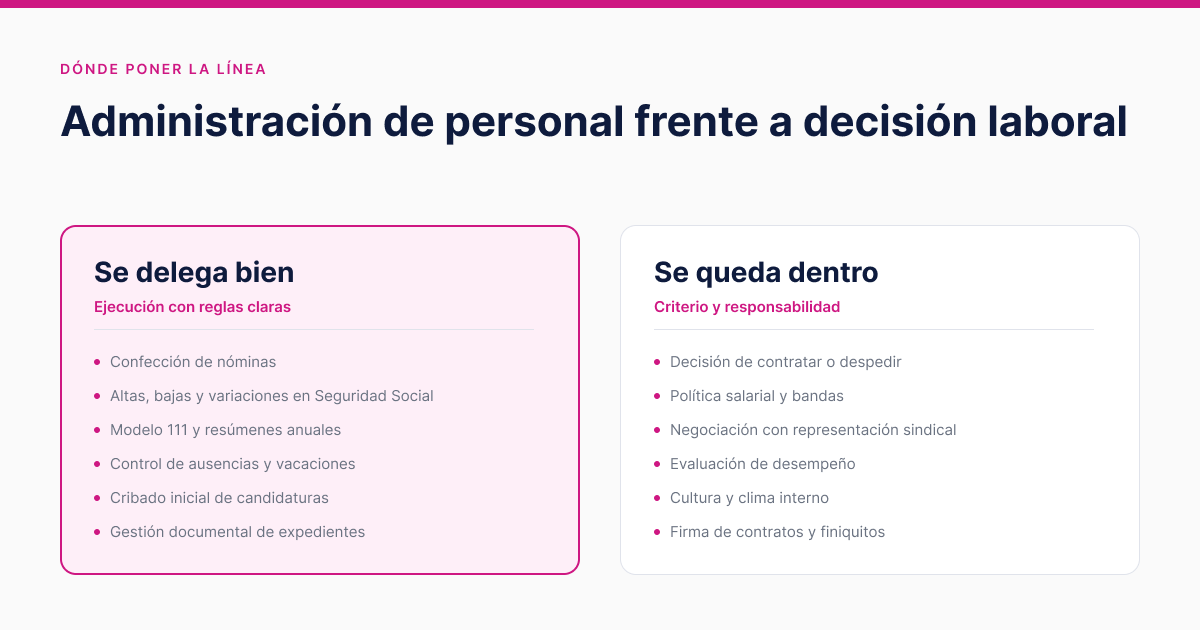
The practical rule of thumb is the same as in accounting: if the task has clear rules, is repetitive, and its outcome is verifiable, it can be delegated effectively. If it involves making a decision about a specific person, it stays in-house.
| Delegates well | It stays inside |
|---|---|
| Payroll Processing | Decision to Hire or Fire |
| Social Security Enrollments, Withdrawals, and Changes | Pay Policy and Pay Bands |
| Form 111 and Annual Summaries | Negotiations with Union Representatives |
| Absence and Vacation Tracking | Performance Evaluation |
| Initial Screening of Applications | Final Selection Decision |
| Document Management for Case Files | Signing of Contracts and Severance Agreements |
Where is the legal line?
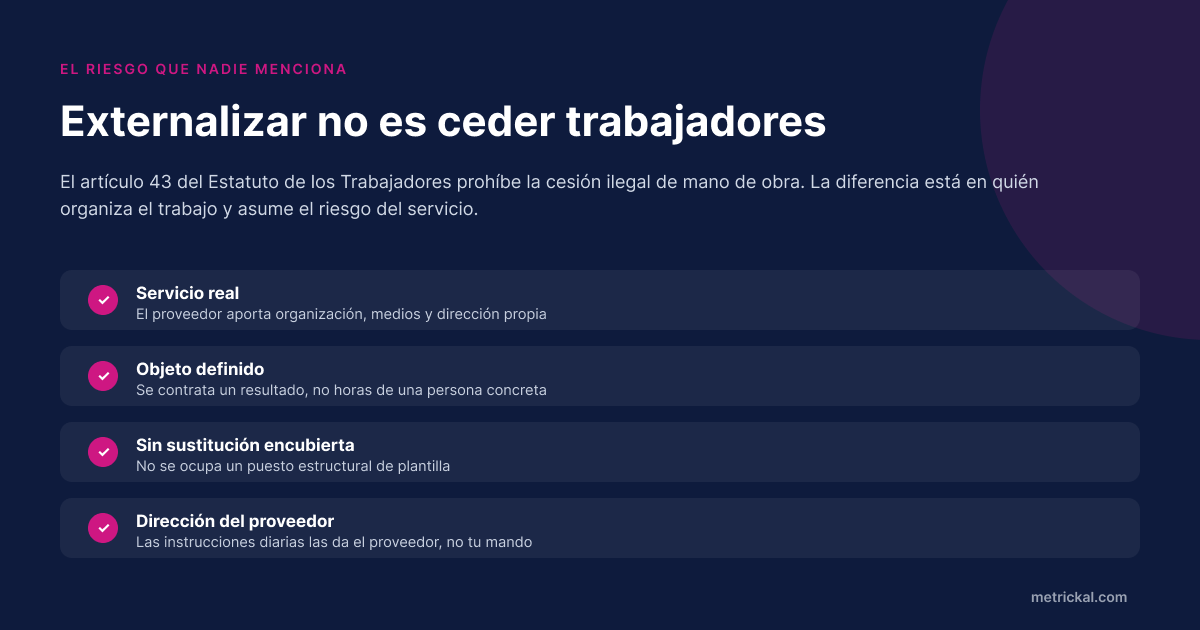
This is the part that almost no one mentions in a business proposal. Article 43 of the Workers’ Statute prohibits the assignment of workers outside of authorized temporary employment agencies. The consequences of crossing that line are significant: the affected workers are entitled to become permanent employees, at their discretion, either at the transferring company or the receiving company, with seniority calculated from the start of the assignment, and both companies are jointly and severally liable for their obligations to the workers and to Social Security.
A legitimate outsourced service meets four conditions:
- The provider brings organization, resources, and its own leadership—not just people.
- You are contracting for a specific result or service, not for a particular person’s hours.
- A permanent position on the staff is not being filled under the table.
- Day-to-day instructions are given by the supplier, not by a manager at your company.
If your provider suggests placing someone in your office—under your supervision—to perform the duties of a position that already exists in your organizational chart, that’s no longer outsourcing. And you’re the one who assumes the risk.
How much does an in-house HR administrator cost?
To make a comparison, you need to consider the total cost. In addition to the gross salary, you must factor in the employer’s share of Social Security contributions, the position itself, payroll software licenses, ongoing training in labor regulations—which change frequently—and absenteeism.
The sector is governed by provincial agreements for offices and law firms, not by a state-wide agreement, so the guidelines depend on where your office is located. It’s a good idea to check the table for your province before doing the math.
The fair comparison is cost per productive hour versus hourly rate, not gross salary versus hourly rate.
How can I get started without taking any risks?
First, what doesn’t concern anyone
Document management for case files and absence tracking. If something goes wrong, you’ll see it before any employee does.
Next, the payroll cycle
Record-keeping, additions and deletions, Form 111. This frees up real-time resources and verifies whether your processes were documented or just existed in someone’s head.
Finally, support for the national team
Initial screening and scheduling coordination. The final decision always remains with the company, and it’s best to put that in writing.
How does this fit into your operation?
Personnel management is rarely outsourced on its own. It’s usually outsourced along with the rest of the back office, and that’s where the local market really makes a difference:
- Back office in Madrid and Bilbao.
- Outsourcing accounting, which is often handled in conjunction with payroll.
- How to Choose a BPO Provider: Questions to Ask Before Signing a Contract.
- The map of cities is under ” Locations.”
Frequently Asked Questions
Which human resources processes can be outsourced?
Human resources administration: payroll processing, Social Security enrollments, terminations, and changes; filing Form 111 for withholding taxes; tracking absences and vacation time; document management for personnel files; and initial screening of job applicants. Everything that follows clear rules and is repeated month after month.
What should never be outsourced?
Decisions. Hiring or firing, setting salary policies and ranges, evaluating performance, negotiating with employee representatives, and signing contracts and severance agreements. A service provider can prepare the documentation for you, but the decision and the signature rest with the company.
Is outsourcing human resources considered an illegal transfer of workers?
No, as long as it is an actual service. Article 43 of the Workers’ Statute prohibits the assignment of workers outside of authorized temporary employment agencies. The difference is that the provider must contribute its own organizational structure and resources, manage its team, and be accountable for the results, rather than simply placing a person under your supervision in a permanent position.
Who is responsible if a payroll goes wrong?
The company remains the employer and is accountable to the employee and to Social Security. That is why it is advisable to establish in writing the deadlines for submission, who reviews the forms before filing, and what happens if a form is filed late. Outsourcing the work does not transfer the status of employer.
When does it make more sense to outsource rather than hire someone full-time?
When there isn’t enough work to fill a full workday all year round, when the workload is concentrated around monthly closings and hiring campaigns, or when a single staff member’s absence blocks payroll processing. If your workforce is stable and large, an in-house team usually works better.
What software do you use?
With yours. A3, Sage, SILTRA for Social Security, Factorial, Personio, or whatever system you already have set up. Switching tools and equipment at the same time unnecessarily increases the risk.
Where to Start
Take the most recent payroll closing and count the hours spent on menial tasks: entering adjustments, reconciling absences, preparing documentation. That number will determine whether this makes sense for you.
If you’d like a calculation based on your numbers, let’s talk.
Legal reference: Article 43 of Royal Legislative Decree 2/2015, the consolidated text of the Workers’ Statute Act, regarding the assignment of workers. The subcontracting of construction work and services is regulated by Article 42. Form 111 of the Tax Agency. Collective bargaining agreements for offices and professional practices are provincial in scope.