
Virtually no company decides to outsource its logistics back office out of the blue. It usually happens after a campaign during which delivery slips piled up, or after a month-end closing when no one knew how many shipments had not yet been invoiced.
The useful question isn’t whether to outsource, but what exactly to outsource. And that’s where bad decisions are made in both directions.
Which processes should be outsourced, and which ones shouldn’t?
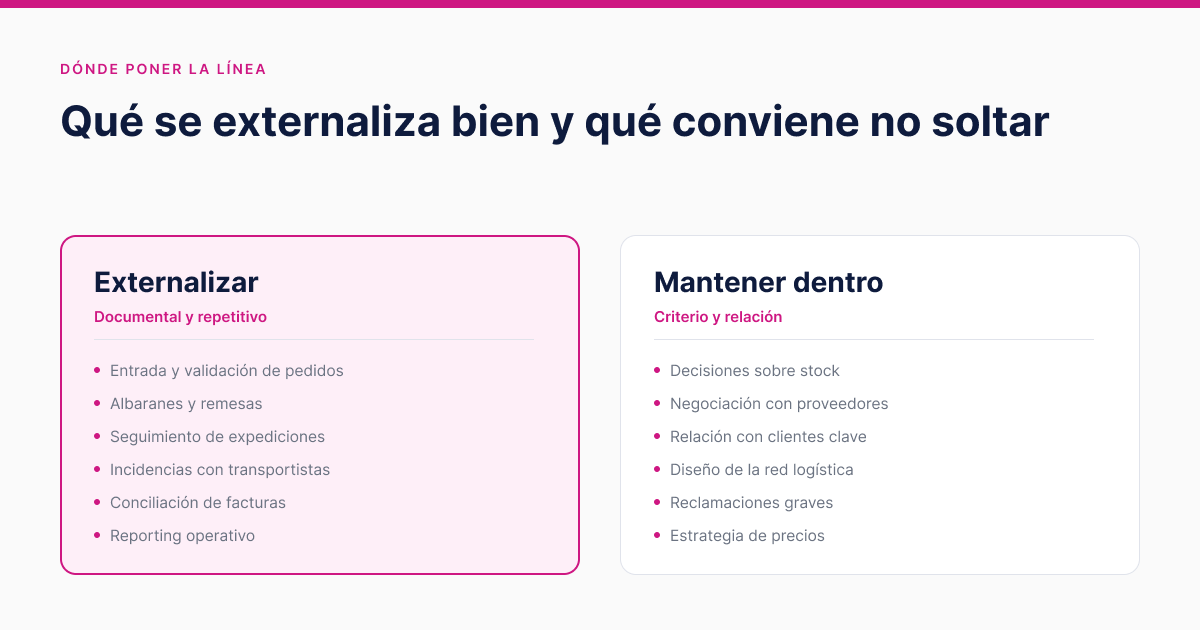
The criteria we use are simple. If the task has clear rules and is repetitive, it’s a good candidate for outsourcing. If it requires business judgment or directly involves an important client, it stays in-house.
| It’s outsourced well | It’s best to keep it inside |
|---|---|
| Order Entry and Confirmation | Decisions Regarding Inventory Levels |
| Delivery Slips and Shipments | Negotiating Rates with Suppliers |
| Shipment Tracking | Relationships with Key Clients |
| Issues with carriers | Distribution Network Design |
| Invoice Reconciliation | Serious complaints or disputes |
| Operational Reporting | Pricing Strategy |
The most common mistake isn’t outsourcing too much. It’s outsourcing the work while still retaining oversight, so that someone on your team ends up reviewing every delegated task. If that happens, you haven’t freed up time—you’ve just shifted it around.
When do you know that your back office isn’t cutting it?
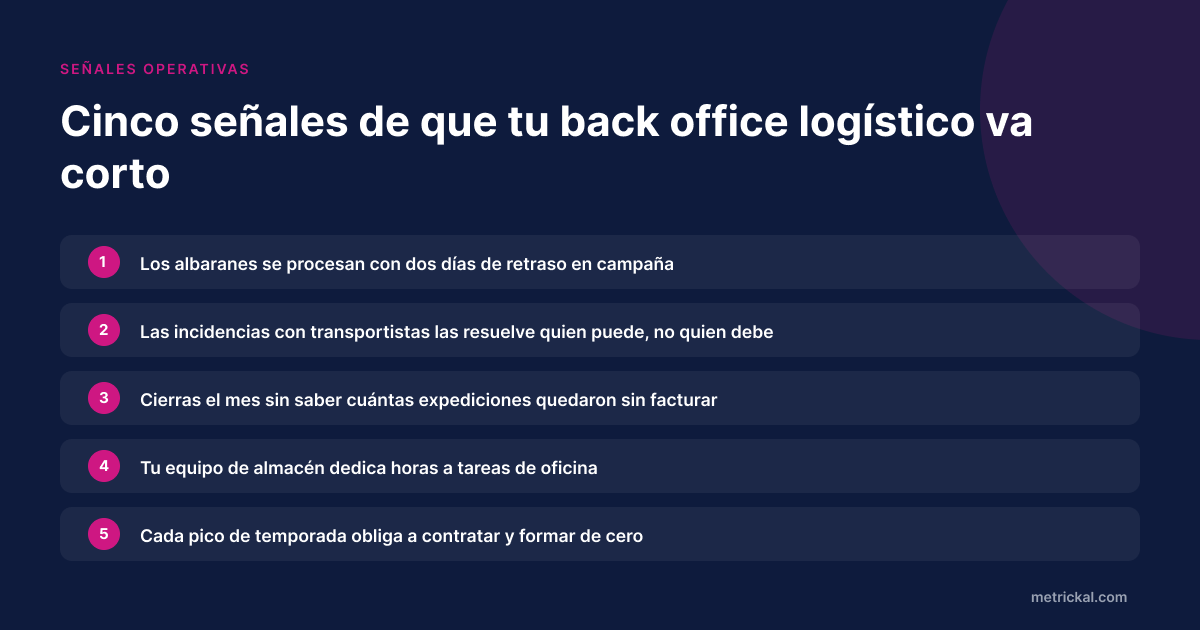
These five almost always appear together, and they’re usually there for months before anyone even notices them.
- Delivery slips are processed two days late during the harvest season, and this delay is now considered normal.
- Issues with carriers are resolved by whoever has an opening, not by whoever has the expertise.
- You close out the month without knowing for sure how many shipments haven’t been invoiced.
- Your warehouse team spends hours of their workday on administrative tasks.
- Every peak season requires us to hire and train new employees from scratch for three months.
The context: more volume, more paperwork
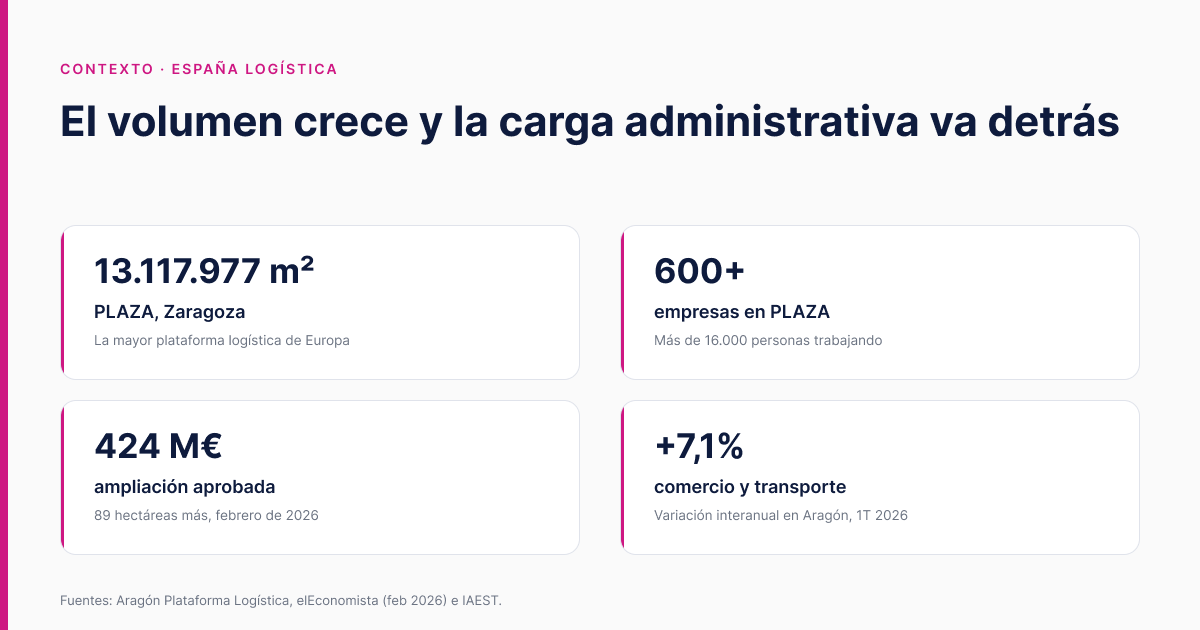
PLAZA, in Zaragoza, is Europe’s largest logistics hub, covering 13,117,977 square meters and home to more than 600 companies that employ approximately 16,000 people. In February 2026, an 89-hectare expansion was approved, involving an investment of 424 million, with the platform already 90% occupied.
At the same time, trade and transportation grew by 7.1% year-over-year in Aragón during the first quarter of 2026, according to the IAEST. That growth doesn’t just come in the form of trucks—it comes in the form of orders to record, delivery slips to match, and invoices to reconcile.
How to Get Started Without Disrupting Operations
Delegating the entire back office all at once on a Monday in October is the quickest way to ensure it goes wrong. What works is doing it in phases.
First, what doesn’t concern the customer
Start with invoice reconciliation and reporting. If something goes wrong, you’ll be the first to notice it.
Next, the document flow
Orders, packing slips, and shipments. This frees up real-time resources for the internal team and reveals whether the processes were well-defined or just existed in someone’s head.
Finally, the part that comes into contact with the outside
Tracking shipments and incidents with carriers. This is the most important step because it requires the team to understand your operations and your risk tolerance.
Where do we do it?
The industry agreement is provincial, so the cost of hiring varies depending on where you set up the team. We’ve broken down each market separately:
- Logistics outsourcing in Zaragoza, with details on PLAZA and its location on the Iberian Peninsula.
- Logistics outsourcing in Valencia, focused on the Port and the Free Trade Zone.
- And if what you need is general administration rather than logistics, back-office services in Madrid or Bilbao.
- You can see all the cities on our locations page.
Frequently Asked Questions
What is the logistics back office?
It refers to the entire administrative process surrounding the physical movement of goods: recording orders, issuing and reconciling delivery notes, tracking shipments, managing issues with carriers, reconciling invoices, and generating reports. It does not include the warehouse or transportation, but rather the paperwork that keeps both running smoothly.
Which logistics processes should not be outsourced?
Those that require independent judgment or involve business relationships. Deciding on inventory levels, negotiating rates with suppliers, handling issues with your major clients when something goes wrong, and designing the distribution network. Outsourcing these tasks means giving up your competitive advantage.
How long does it take to get a team up and running?
At Metrickal, it takes less than three weeks: process assessment in the first few days, workflow design, two weeks of candidate screening and training on your operations, and onboarding with shadowing. With a suitable candidate available and a genuine sense of urgency, it takes 48 hours.
How are peak campaign periods managed?
Increase hours instead of hiring more staff. You can bring on extra help for Black Friday or the Christmas season and return to normal staffing levels in January without having to extend contracts. Starting at 20 hours per week, with 15 days’ notice if it doesn’t work out.
Does the external team work in my ERP or in another system?
In yours. We integrate with SAP, Oracle NetSuite, Odoo, Sage, and Microsoft Dynamics, as well as the industry-standard TMS and WMS systems. Access via SSO with MFA, least-privilege permissions, and auditable logs.
What happens if someone on the team leaves?
Replacement within 72 hours with no penalty, and sick leave and vacation time are covered in the price. In logistics, this matters more than it seems: a single unprocessed delivery slip can hold up an entire shipment.
Where to Start
Take your last month-end closing and count how many hours your team spent on menial tasks: logging, reconciling, chasing down. That number is what determines whether this makes sense for you—and it’s almost always surprising.
If you’d like a calculation based on your numbers, let’s talk.
Sources: Aragón Logistics Platform (area and data from PLAZA), elEconomista (February 25, 2026), and the Aragonese Institute of Statistics (quarterly reports, first quarter of 2026).