
Nearshore outsourcing allows companies to reduce costs, improve communication, and operate more efficiently by working with teams in nearby countries. This strategy combines cost savings with operational control and real-time collaboration.
We’re able to scale teams seamlessly, while maintaining quality and speed. Throughout this article, we explain how it works, why it matters, and when to use it. Keep reading to learn how to put it into practice.
Key Benefits of Nearshore Outsourcing for Businesses
Before going into detail, let’s summarize the key benefits we need to understand in order to make better strategic decisions regarding modern business outsourcing.
- Reduce costs without compromising operational quality
- Improves communication due to cultural and time zone similarities
- Enables quick and flexible scaling of equipment
Cost savings without compromising quality

Cost savings are one of the most compelling reasons for companies to adopt nearshore outsourcing when seeking financial efficiency without compromising operational performance.
- Reduction in labor costs of between 50% and 70%
- Lower training and onboarding costs
- Elimination of hidden costs such as long-distance travel
- Better value for money compared to in-house equipment
- Access to competitive talent at a lower cost
We use these savings to reinvest in growth, innovation, and continuous improvement without increasing our internal operational burden.
Time zone compatibility for real-time work

Working with teams in similar time zones enables seamless collaboration, quick decision-making, and more efficient project execution.
“Companies sought to reduce costs and improve efficiency and collaboration by taking advantage of similar time zones, culture, and a common language across various countries.” – Ciencia Latina
- Time difference of 1 to 3 hours on average
- Meetings without the need for extreme schedules
- Immediate response to changes or incidents
- Faster development cycles
- Fewer rework issues due to a lack of coordination
This coordination allows us to operate as a single team. When analyzing the differences between nearshoring and offshoring, it becomes clear that proximity helps avoid the operational and communication delays that are common in purely remote models.
Cultural and linguistic alignment

Credits: Susi Green
Cultural affinity facilitates clear communication, reduces errors, and improves day-to-day relationships between internal and external teams.
- Supported languages or languages that can be easily aligned
- Similarities in work culture and values
- A better understanding of business objectives
- Reducing operational misunderstandings
- Greater integration among teams
We’ve achieved a more natural way of working together, which has a direct impact on productivity and the quality of our work.
Ease of management and monitoring
Geographical proximity simplifies operational management, allowing for greater control and more effective oversight of outsourced teams.
- In-person visits are available
- Simpler and more frequent audits
- Greater visibility into performance
- Quick adaptation to strategic changes
- Improved quality control
This allows us to maintain high standards without complicating the organizational structure.
Scalability and operational flexibility
Nearshore outsourcing makes it easy to scale the team according to business needs without lengthy or costly processes.
- Scale teams in weeks, not months
- Reduce capacity during periods of low demand
- Adapt quickly to new projects
- Optimize internal resources
- Improve return on investment
We use this flexibility to respond to market conditions without friction or operational overhead.
Access to specialized talent
The nearshore model provides access to highly skilled professionals in various fields without strict geographical limitations.
- This model makes it possible to hire top-tier software developers in Latin America, bringing together IT specialists and qualified technical support teams who already have experience with international projects.
- Teams of qualified technical support staff
- Professionals with international experience
- Lower turnover than in offshore models
- Availability of profiles that are hard to find locally
This allows us to build strong teams without relying solely on the local job market.
Mitigation of operational and legal risks
Working with neighboring countries helps minimize regulatory risks and improves business continuity in changing environments.
“The advantages of nearshoring […] include reduced logistics and transportation costs; greater control and quality oversight; easier communication and collaboration; mitigation of geopolitical and commercial risks; and a faster response to market changes.” – UNAM
- Clearer compliance with regulations
- Reduced exposure to legal risks
- Greater operational stability
- Better data protection
- The most reliable service continuity
We reduce uncertainty and operate with greater confidence at every stage of the process.
Quick comparison: nearshore vs. other models
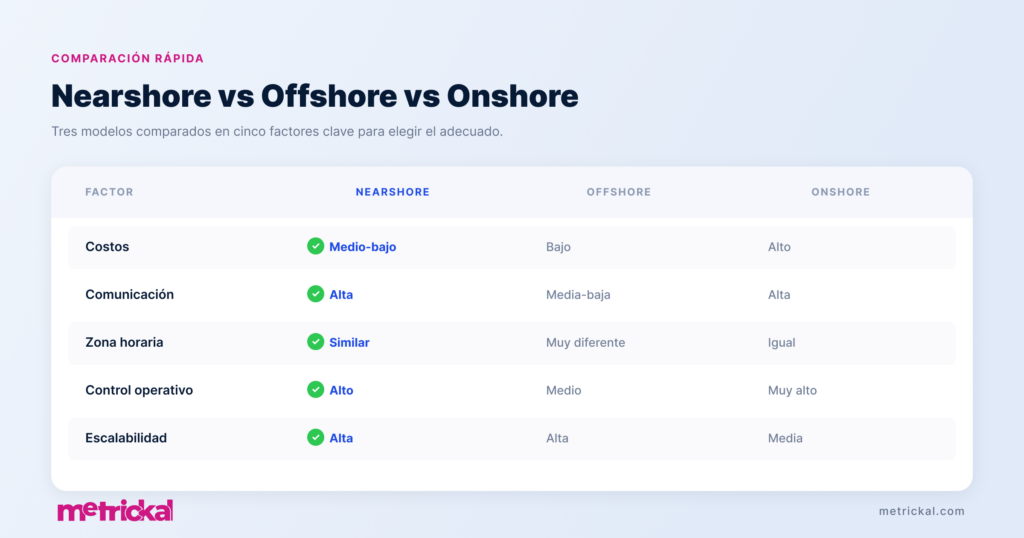
To better understand the value of nearshore outsourcing, we compare its characteristics with those of other common approaches used by companies.
| Factor | Nearshore | Offshore | Onshore |
| Costs | Low to medium | Bass | High |
| Communication | Sign Up | Low to medium | Sign Up |
| Time zone | Similar | Very different | Same |
| Operational control | High | Medium | Very high |
| Scalability | Sign Up | Sign Up | Average |
This comparison helps us choose the right model based on our operational and strategic priorities.
How to Implement Nearshore Outsourcing Effectively
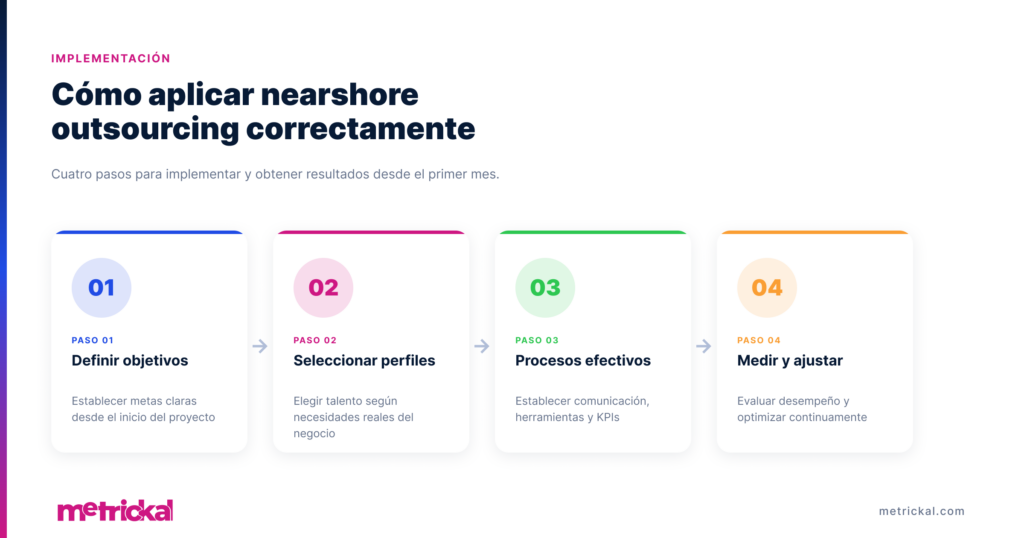
Implementing nearshore outsourcing requires clear planning to maximize benefits and avoid common issues during the initial rollout.
- Set clear goals from the start
- It is essential to select candidates based on the business’s actual needs. For example, in critical areas such as finance and accounting outsourcing
- Establish effective communication processes
- Continuously measure performance
- Adjust equipment based on results
We view the implementation as an extension of the internal team, not as a standalone resource.
FAQ
When is it better to choose nearshore outsourcing instead of hiring an in-house team?
Nearshore outsourcing is a good choice when you need to grow quickly without increasing fixed costs. It’s also useful when you can’t find local talent or want to reduce your operational burden.
This model allows us to access skilled professionals without going through lengthy hiring processes. In addition, we can maintain constant oversight and communication without compromising the quality of the work delivered.
What types of companies benefit most from nearshore outsourcing?
Growing companies tend to benefit most from nearshore outsourcing. This is especially true for startups, SaaS companies, and businesses with digital operations. This model is helpful when we need to scale teams without expanding our internal infrastructure.
It is also useful for organizations seeking operational efficiency, cost savings, and greater flexibility to adapt to market changes.
How is success measured in a nearshore outsourcing strategy?
Success is measured using clear metrics such as productivity, cost savings, and service quality. We also evaluate response times, goal achievement, and team stability.
It is important to review results on an ongoing basis in order to make adjustments. A good strategy strikes a balance between operational efficiency and sustainable business growth.
What challenges might arise when implementing nearshore outsourcing?
Challenges may arise, such as a lack of clarity in processes or initial communication. Difficulties may also arise if we do not clearly define our objectives from the outset. However, these problems can be minimized with proper planning.
Establishing clear expectations, tracking tools, and communication channels helps ensure that operations remain efficient and aligned.
Benefits of nearshore outsourcing for businesses
Nearshore outsourcing allows us to reduce costs, improve communication, and scale operations without compromising control or process quality. This combination makes it a practical option for companies seeking sustainable growth. We can apply this model to optimize resources, access qualified talent, and
respond more quickly to demand. If we want to leverage these advantages with a strategic and flexible approach, we can do so with metrickal, aligning our operations with real growth.
References
- https://ciencialatina.org/index.php/cienciala/article/view/12688/18342
- https://www.dgcs.unam.mx/boletin/bdboletin/2023_338.html