
Nearshoring and offshoring are two outsourcing strategies we use to reduce costs and scale operations, but they differ mainly in terms of geographic location and operational impact.
While nearshoring involves working with nearby countries, offshoring focuses on more distant destinations with lower labor costs. Each model has clear advantages and limitations. Below, we explain the key differences to help you make a better decision.
Keys to the article
Before going into detail, we summarize the three most important points to understand in order to make an informed decision about these models.
- Nearshoring improves communication and operational speed thanks to geographical proximity.
- Offshoring offers greater cost savings, but with more operational complexity.
- The choice depends on priorities: operational efficiency or maximum cost reduction.
What is nearshoring and offshoring?

Both models seek to optimize costs and operations, but work differently depending on the location and type of collaboration we establish.
“While offshoring refers to outsourcing to countries distant from the company’s headquarters, nearshoring is adjacent outsourcing (i.e., it takes place in neighboring countries with shared geographic boundaries and cultural affinity).” – the Revista Facultad de Ciencias Económicas
- Nearshoring: we move operations to nearby countries, generally in the same time zone.
- Offshoring: we move operations to distant countries with lower labor costs.
Nearshoring facilitates real-time communication and reduces cultural friction. Offshoring prioritizes cost savings, but can complicate day-to-day coordination and supervision.
Key differences between nearshoring and offshoring
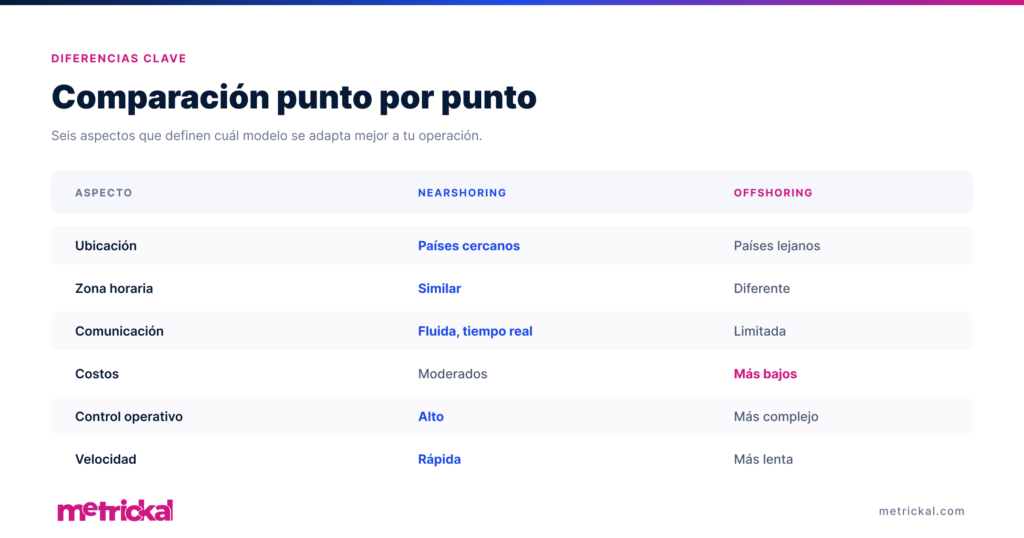
To better understand these models, we compare the most relevant aspects that directly impact our daily operations.
| Appearance | Nearshoring | Offshoring |
| Location | Nearby countries | Distant countries |
| Time zone | Similar | Different |
| Communication | Fluid and in real time | Limited by timetable |
| Costs | Moderate | Lower |
| Operational control | High | More complex |
| Speed | Quick | Slower |
Advantages of nearshoring
Credits: Isupport WorldWide
Near-shoring focuses on improving operational efficiency without completely sacrificing control and quality of work.
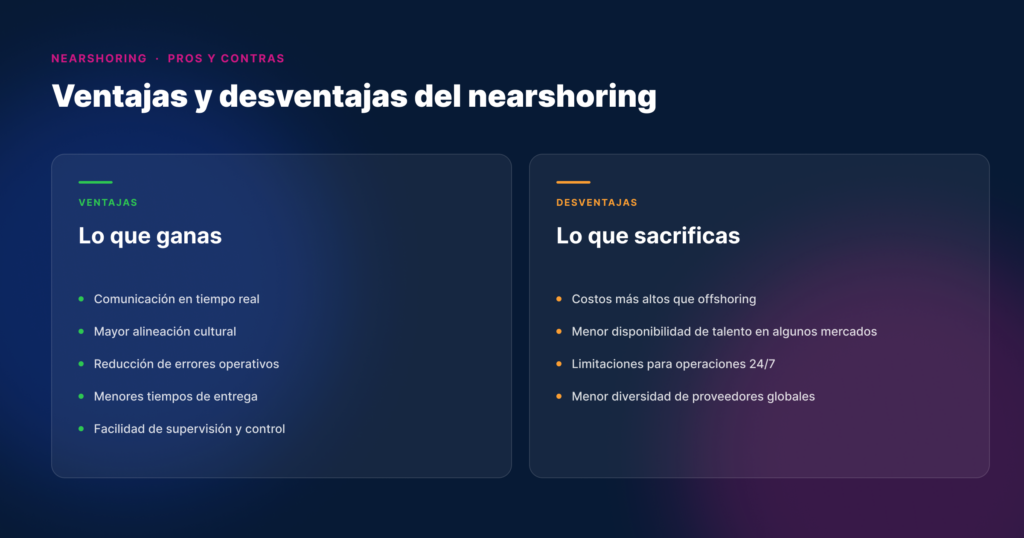
- Real-time communication with teams.
- Greater cultural and business alignment.
- Reduction of operational errors.
- Shorter delivery times.
- Easier supervision and control.
This model works well when we need agility and constant coordination. This is why many organizations look for the best nearshore BPO companies for startups that allow frequent interaction between teams without the friction of distance.
Disadvantages of nearshoring
Although efficient, nearshoring also has limitations that we must consider before implementing it in our operations.
- Higher costs than offshoring.
- Reduced availability of talent in some markets.
- Limitations for 24/7 operations.
- Reduced diversity of global suppliers.
These limitations can affect whether we are looking to reduce costs as much as possible or to scale quickly with large volumes of work.
Advantages of offshoring
Offshoring is designed to maximize cost efficiency and enable greater scalability in global operations.
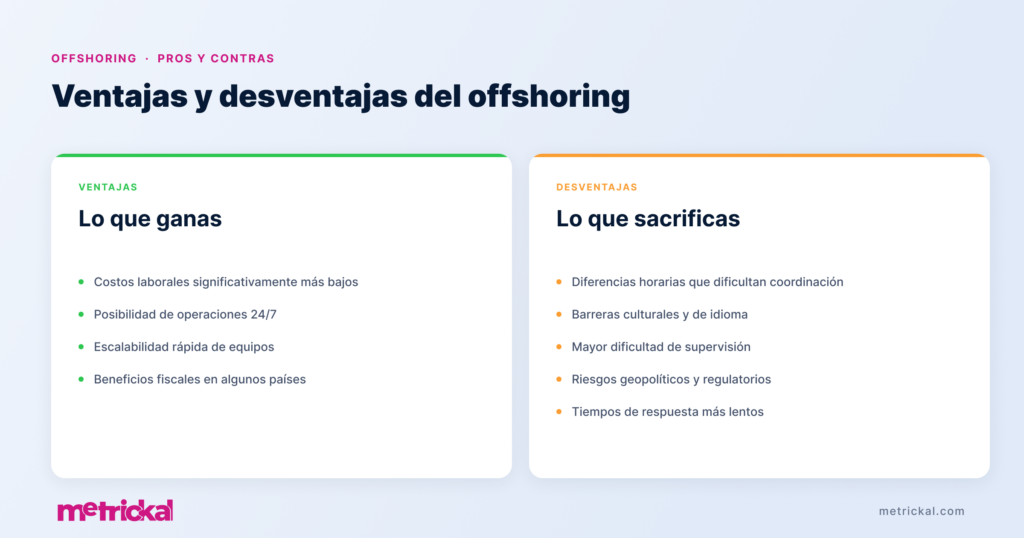
- Significantly lower labor costs.
- In addition to savings, these strategies allow access to specialized centers, as is the case with nearshore software development in Colombia, where technical scale and time proximity combine to empower global teams.
- Possibility of 24/7 operations.
- Rapid equipment scalability.
- Tax benefits in some countries.
This model is ideal when the main objective is to reduce costs and operate with large volumes of work.
Disadvantages of offshoring
Despite the savings, offshoring introduces operational complexities that can affect the quality and efficiency of the work.
- Time zone differences that make coordination difficult.
- Cultural and language barriers.
- Greater difficulty in supervision.
- Geopolitical and regulatory risks.
- Slower response times.
These factors can generate operational friction if we do not have well-defined processes and constant control.
When to choose nearshoring or offshoring
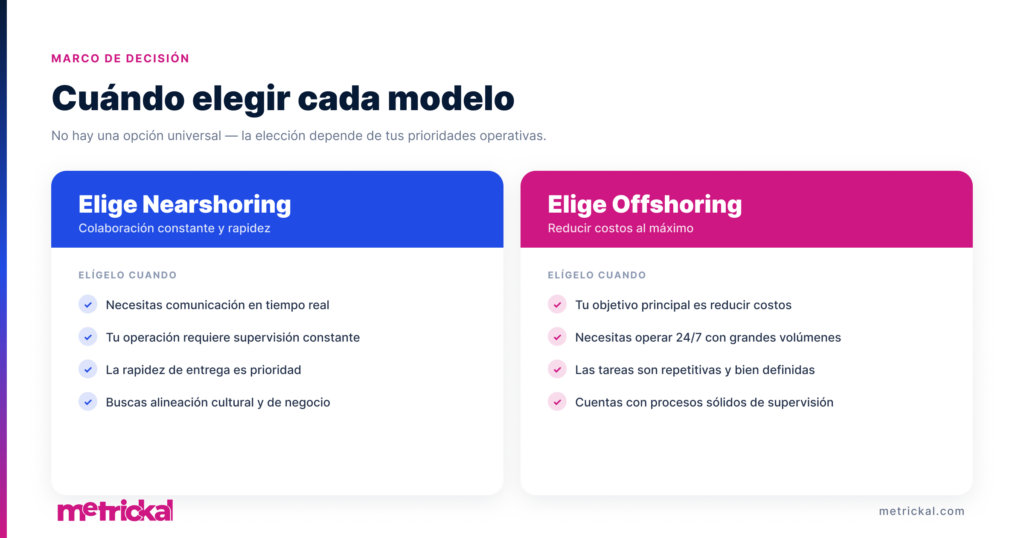
The decision depends on our operational priorities, level of control required and the speed of execution we are looking for in the business.
“The advantages of nearshoring include: cultural proximity, faster turnaround times with reduced costs, lower language barriers, similar schedules, and greater control and oversight. Offshoring, meanwhile, offers benefits such as significant cost reductions and greater ability to scale operations.” – UNIR Magazine
- We choose nearshoring when we need constant collaboration and speed.
- We opt for offshoring when the main objective is to reduce costs.
- We consider the type of task and level of complexity.
- We evaluate the impact on communication and supervision.
- We analyze the need to operate in real time.
There is no universal choice. The best decision depends on the specific context of our operations.
How it fits into an outsourcing strategy
Nearshoring and offshoring are not isolated decisions, but part of a broader strategy to optimize our operations.
- They integrate with remote and distributed equipment.
- They allow scaling without increasing the internal structure, delegating critical processes to specialists. A clear example is the support of payroll outsourcing companies in Latin America, which improve efficiency in complex administrative tasks.
- Improve efficiency in repetitive processes.
- Facilitate access to specialized talent.
- They help reduce total operating costs.
When used correctly, these models become a clear competitive advantage.
FAQ
What factors influence the choice between nearshoring and offshoring?
The decision depends on several factors such as budget, type of operation and communication needs. Nearshoring works best when we need constant collaboration and speed.
Offshoring is more appropriate if we are looking to reduce costs in repetitive tasks. We must also consider time zone, complexity of the work and level of supervision required to maintain quality.
Is nearshoring or offshoring better for growing startups?
For startups, the decision depends on the pace of growth and available resources. Nearshoring usually facilitates coordination and quick decision making, which is key in early stages.
Offshoring can help reduce costs, but it requires more structure to manage it. Making the right choice depends on how much control and flexibility we need in our day-to-day operations.
How does the time zone impact nearshoring and offshoring?
Time zone directly influences communication and productivity. Nearshoring allows working at similar times, which facilitates meetings and quick problem resolution. In offshoring, time differences can delay processes or require asynchronous work.
This can be useful for continuous operations, but complicates real-time collaboration between teams.
What operational risks exist in nearshoring vs. offshoring?
In nearshoring, the main risk is higher cost or limited talent in certain markets. In offshoring, risks include cultural barriers, communication problems and less operational control.
Delays or errors can also arise if there are no clear processes. Identifying these risks earlier helps to avoid problems during execution.
Nearshoring vs. offshoring: which one to choose for growth?
Nearshoring vs. offshoring is not a one-size-fits-all decision, but a strategic one based on our priorities. If we are looking for real-time collaboration and operational control, nearshoring offers greater efficiency. If our primary objective is to reduce costs, offshoring may be more appropriate.
In our case, we work to help companies scale without increasing operational complexity. If we want to optimize costs and efficiency with a flexible approach, we can explore tailored solutions together with Metrickal.
References
- https://dialnet.unirioja.es/descarga/articulo/8358180.pdf
- https://colombia.unir.net/actualidad-unir/nearshoring-offshoring/