
Accounting is one of the first things a company considers delegating—and one of the hardest to delegate—because the conversation usually starts with the price rather than with where to draw the line.
The useful question isn’t whether to outsource. It’s which part, and who remains responsible for it.
What should be delegated, and what should be handled in-house?
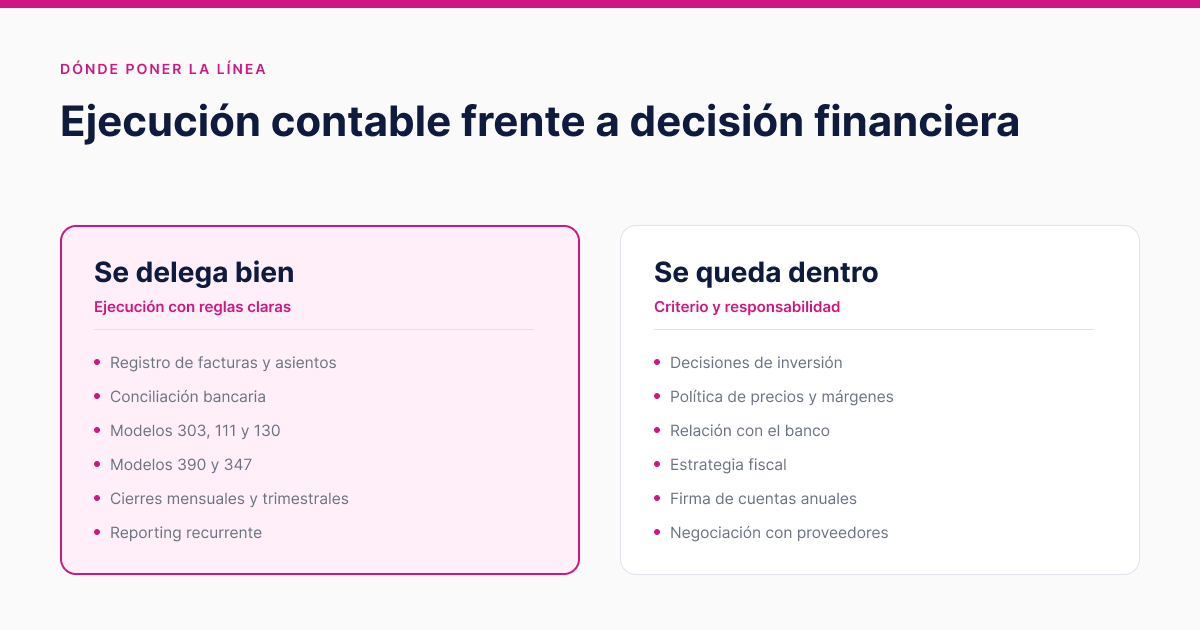
The practical rule of thumb: if the task has clear rules, is repetitive, and its outcome is verifiable, it’s a good candidate for delegation. If it requires judgment about your business or involves your legal liability, keep it in-house.
| Delegates well | It stays inside |
|---|---|
| Recording of Invoices and Journal Entries | Investment Decisions |
| Bank Reconciliation | Pricing and Margin Policy |
| Models 303, 111, and 130 | Relationship with the bank |
| Annual Summaries 390 and 347 | Tax Strategy |
| Monthly and Quarterly Closings | Signing of the Annual Financial Statements |
| Recurring Reporting | Negotiating with Suppliers |
There is one point that needs to be made clear: outsourcing the filing process does not transfer liability to the tax authorities. The company remains the taxpayer. A vendor can prepare and file a tax return for you, but if it’s filed late or incorrectly, you’re the one held liable. That’s not an argument against outsourcing; it’s an argument in favor of establishing deadlines and review procedures in writing.
When Does Internal Accounting Fall Short?
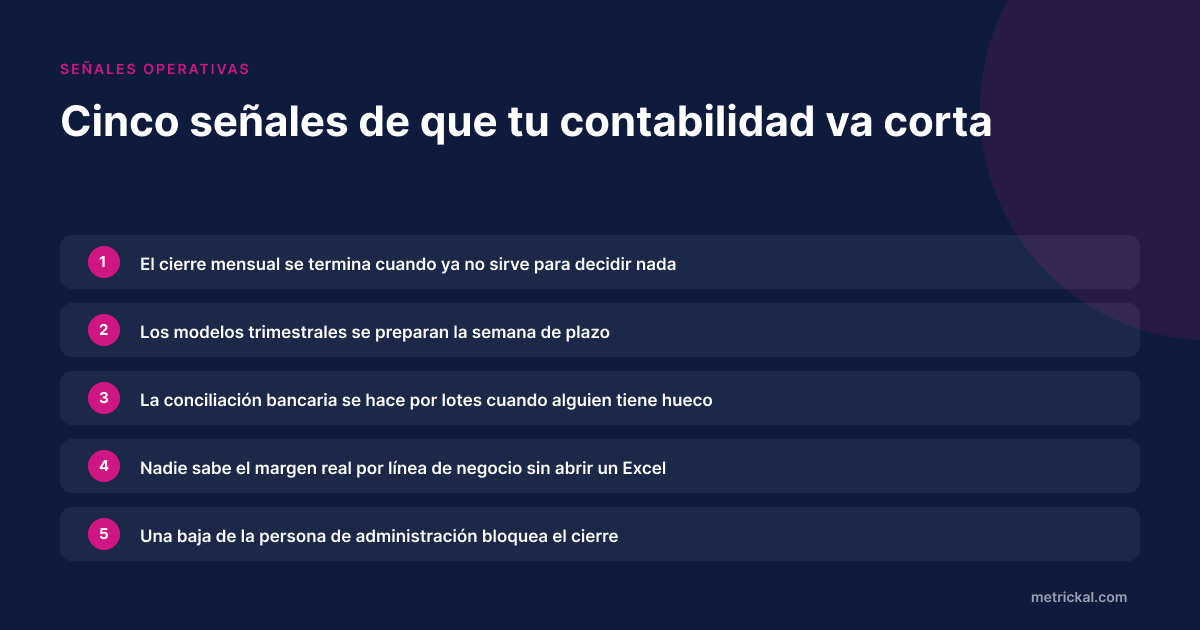
These five almost always appear together, and none of them has anything to do with the ability of the person wearing the numbers.
- The monthly closing is over once it no longer serves any purpose in decision-making.
- Quarterly reports are prepared during the same week as the deadline.
- Bank reconciliation is done in batches, whenever someone has a free moment.
- No one knows the actual margin by business line without opening a separate Excel file.
- If an administrator is removed, the entire closing process is blocked.
The last one hurts the most and is the least expected. A one-person team has no backup, and accounting doesn’t allow for breaks because the deadlines set by the Tax Agency don’t change.
How much does an in-house accountant cost compared to outsourcing?
To make a true comparison, you need to consider the total cost, not just the salary. In addition to the gross annual salary, you must factor in the employer’s share of Social Security contributions, the position, accounting software licenses, ongoing training on regulations, and absenteeism.
In Spain, the sector is governed by provincial collective bargaining agreements for offices and law firms, not by a national one, so the terms vary depending on where your headquarters are located. The Community of Madrid, for example, approved its salary adjustment for 2026 in March of that year.
The fair comparison is cost per productive hour versus hourly rate. Anything else inflates the savings, and it becomes apparent by the third month.
How can I make the transition without breaking anything?
Delegating the entire cycle all at once, right in the middle of the quarterly close, is the quickest way to ensure it goes wrong. What works is doing it in phases.
First, matters that do not concern third parties
Bank reconciliation and recording of received invoices. If something goes wrong, you’ll be the first person outside the company to notice it.
Next, the recurring patterns
303, 111, and 130. This frees up real time, and you can see whether your processes were documented or just existed in someone’s head.
Finally, closings and reporting
It’s the final step because it requires the team to understand your workflow and your allocation criteria. Before that, any closing will be a rough approximation of what you would do.
How does this fit into the rest of your operation?
Accounting is rarely outsourced on its own. It’s usually outsourced along with the rest of the administrative back office, and that’s where the local market really makes a difference:
- Back offices inMadrid and Bilbao, where the applicable collective bargaining agreement is provincial.
- Which logistics back-office processes should you outsource if your volume comes from merchandise?
- How to Choose a BPO Provider in Spain: Questions to Ask Before Signing a Contract.
- The map of cities is under ” Locations.”
Frequently Asked Questions
What accounting tasks can be outsourced?
Anything that has clear rules and is repetitive: recording issued and received invoices, journal entries, bank reconciliation, preparation and filing of Form 303 (VAT), Form 111 (withholdings), and Form 130 (personal income tax), the annual summaries 390 and 347, monthly and quarterly closings, and recurring reporting.
What should you never outsource?
Investment decisions, pricing and margin policies, relationships with the bank, tax strategy, and the signing of the annual financial statements. An outside team can prepare the information you need to make these decisions, but the decision itself and the legal responsibility remain yours.
Does outsourcing my accounting take away my control over my numbers?
Only if you set it up incorrectly. The way to avoid this is to require read access to the system where the accounting data is stored, not just to the monthly report. If you work with your own software and the external team logs in with individual credentials, you’ll see the same information you would with an in-house accountant.
Who is liable to the tax authorities if there is an error?
The Company. Outsourcing the filing process does not transfer tax liability, which remains with the taxpayer. For this reason, it is advisable to establish in writing the deadlines for submission, who reviews the forms before filing, and what happens if a form is filed late.
When does it make more sense to outsource rather than hire someone?
When the workload doesn’t justify a full-time position, when work is concentrated during quarterly peaks, or when a single employee’s absence prevents the books from being closed. If your accounting workload is enough for one full-time person year-round and the process is stable, having your own staff is usually the better option.
What software is needed?
Yours. We work within the stack you already use, whether it’s Sage, A3, Contasol, Holded, Odoo, or whatever ERP you have set up. Switching tools at the same time you switch teams unnecessarily multiplies the risk.
Where to Start
Take your most recent quarterly closing and count how many hours were spent on mindless tasks: recording, reconciling, balancing, and chasing down invoices. That number determines whether this makes sense for you—and it’s usually surprising.
If you’d like a calculation based on your numbers, let’s talk.
References: Tax Agency forms 303, 111, 130, 390, and 347. The agreements for offices and practices are provincial in scope; therefore, the applicable tables vary depending on the province where the office is located.