Ask five UK providers for out-of-hours cover and four will quote you an overflow service. The words get used as if they mean the same thing.
They do not, and the difference decides whether your cover holds on Black Friday or quietly fails at 7pm on an ordinary Tuesday.
What is the difference between out-of-hours and overflow?
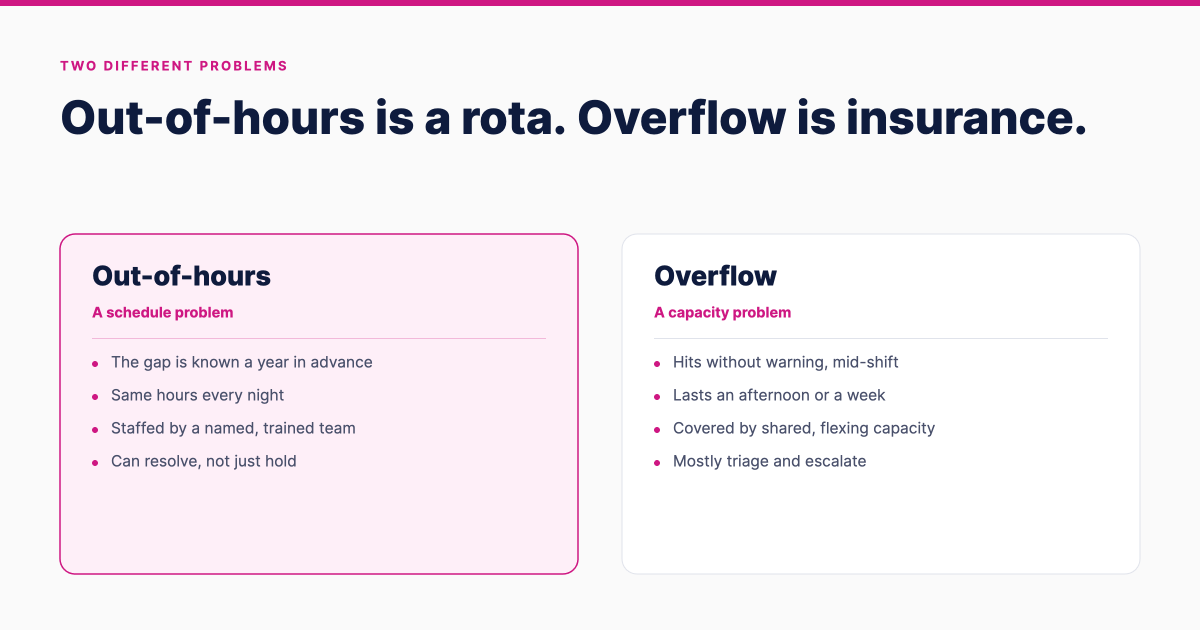
Out-of-hours is defined by the clock. Your team finishes at six, the store does not, and everything that arrives between six and nine the next morning lands in a queue nobody is watching. The gap is completely predictable. You can write down its exact hours for the next twelve months.
Overflow is defined by volume. Your team is at their desks and working, and more contacts arrive than they can answer. It can happen at eleven in the morning on a day you expected to be quiet, because a delivery partner missed a region or an email campaign landed better than planned.
One is a rota. The other is insurance. Buying the second and calling it the first is the single most common mistake in this category.
Why the distinction changes the staffing model
Predictable hours can be staffed by a named, trained team who know your returns policy and your courier rules, because the shift exists every night whether or not contacts arrive. Unpredictable spikes cannot be staffed that way without paying for people to sit idle, so they are covered by shared capacity that flexes.
That difference shows up in quality. The night team can resolve. The spike team can mostly triage, hold and escalate, because they are covering several accounts and cannot hold deep product knowledge for all of them. Knowing which you are buying tells you what to expect at the other end.
What actually arrives after 6pm
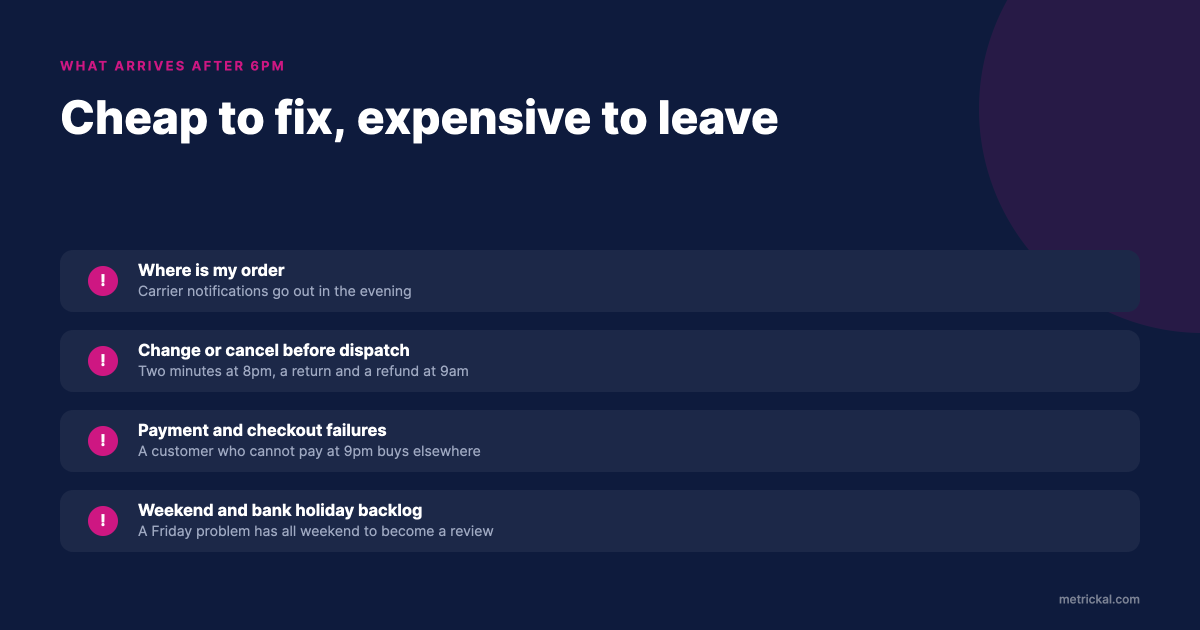
Evening contacts are not a smaller version of daytime contacts. They skew heavily towards a handful of things, and nearly all of them are cheap to fix and expensive to leave.
- Where is my order. Carrier notification emails and app alerts go out in the evening, so the questions they trigger arrive in the evening too.
- Change or cancel before dispatch. Wrong address, wrong size. Answered at 8pm it is a two-minute edit. Answered at 9am it is a return, a refund and a second delivery.
- Payment and checkout failures. A customer who cannot complete an order at 9pm does not wait until morning. They buy elsewhere.
- Weekend and bank holiday backlog. A Friday evening problem left until Monday has had the whole weekend to turn into a complaint or a public review.
The pattern matters because it tells you the cover does not need your full daytime skill set. It needs order system access and permission to act.
How big is the evening gap in the UK?
Online was 28.8% of total UK retail sales in September 2026, according to the Office for National Statistics. That is the share of retail that has no closing time at all, sitting against support rotas that mostly still run nine to six.
We are not going to put a percentage on how many of those contacts arrive after hours, because the honest answer is that it varies enormously by category and nobody publishing a number on this has measured yours. Your own helpdesk already holds that data. Export the last ninety days of contacts, group them by hour received, and the shape of your gap will be obvious in about ten minutes.
What you should not cover out of hours
Covering everything at night is how out-of-hours gets expensive and then gets cancelled. Some things are genuinely better left until the morning.
- Anything needing a commercial decision. Goodwill above a set limit, disputed chargebacks. Set the threshold, let the night team log it, decide in daylight.
- Complaints that need a specialist. A formal complaint answered quickly and badly at midnight is worse than one acknowledged at midnight and answered properly at ten.
The useful instruction to a night team is not “handle everything”. It is “resolve anything inside these rules, acknowledge everything else with a time commitment, and escalate this short list immediately”.
How the cover is actually built
There are three ways to staff a UK evening and they are not equally good.
Paying your own team a shift premium works and is the most expensive per contact, because evening volume rarely justifies a full seat. An automated holding reply costs almost nothing and resolves almost nothing, which is fine for a 2am edge case and poor for a 7pm order change. The third option is to use a team whose working day already overlaps your evening, so the shift is somebody’s normal daytime rather than a night premium.
That is the model we run. We are a BPO with its base in Barcelona, Account Managers in Spain and delivery teams in 10 countries across three continents, most often the Philippines and Colombia. A UK evening sits inside a normal Manila working day, which is why that cover costs what it does and why the people on it are not working a night shift. It is the same structure behind the support we run for Flipdish and Zerca!.
If you want the full picture of how this sits alongside daytime cover, it is on our UK ecommerce outsourcing page, and the questions worth asking any provider are in how to evaluate an outsourced customer service team.
Frequently asked questions
What is the difference between out-of-hours and overflow customer service?
Out-of-hours covers a known, fixed gap in your rota, so it can be staffed by a named team on a schedule. Overflow covers unpredictable volume spikes while your team is already working, so it is bought as flexible capacity. They need different staffing models and different service levels.
Do I need both?
Most ecommerce brands need out-of-hours permanently and overflow seasonally. If you only buy one, start with out-of-hours, because that gap exists every single night rather than on the dozen days a year when volume spikes.
What should an out-of-hours team be allowed to do?
Enough to resolve the common evening contacts without waking anyone: order lookup, address changes and cancellations before dispatch, and refunds up to an agreed limit. Without write access to the order system they can only apologise, which is not cover.
How do I work out how many contacts arrive outside my hours?
Export ninety days of tickets from your helpdesk and group them by the hour they were received, not the hour they were answered. Answered time hides the gap, because everything that came in overnight shows up at nine the next morning.
Does out-of-hours cover have to be 24/7?
No, and starting at 24/7 is usually a waste. Extending to around 10pm and adding weekend daytime covers the bulk of evening contacts for most UK retailers, and you can widen later once you have the hourly data.
What service level should I ask for on overflow?
Ask for the answer threshold and the window it applies to, plus an abandon rate ceiling if it is voice, and get both in the contract rather than the proposal. Also ask what happens when the spike lasts a week instead of a day, because that is the case where shared capacity runs out.
Where to start
Pull the hourly contact chart before you talk to any provider. It takes a few minutes, it tells you the exact hours worth covering, and it stops you buying a 24/7 package to solve a 6pm to 10pm problem.
Then write the rules before the rota: what the team can resolve, what it acknowledges, what it escalates. A provider who asks for that document on the first call is reading the job correctly.
Send us your hourly chart and we will tell you what we would cover and what we would leave. Book 15 minutes.
Source: Office for National Statistics, Retail sales, Great Britain: September 2026, released 23 October 2026. Internet sales were 28.8% of total retail sales.