In a company with fifteen employees, the back office isn’t a department. It’s one person who handles administrative tasks—and, when that person gets overwhelmed, the founder ends up processing invoices on a Sunday afternoon.
That’s why the useful question isn’t whether to outsource, but exactly which part, and in what order.
What counts as back office in an SME?
The back office encompasses all the work that supports operations without the customer seeing it: processing information, validating documents, keeping records up to date, and preparing the data that others use to make decisions. In a large company, this work is divided among administration, finance, and operations. In an SME, it’s usually concentrated in one or two people who also handle other tasks.
That concentration of responsibilities is the real problem. It’s not the cost; it’s that the process exists solely in one person’s head and comes to a halt when that person goes on vacation.
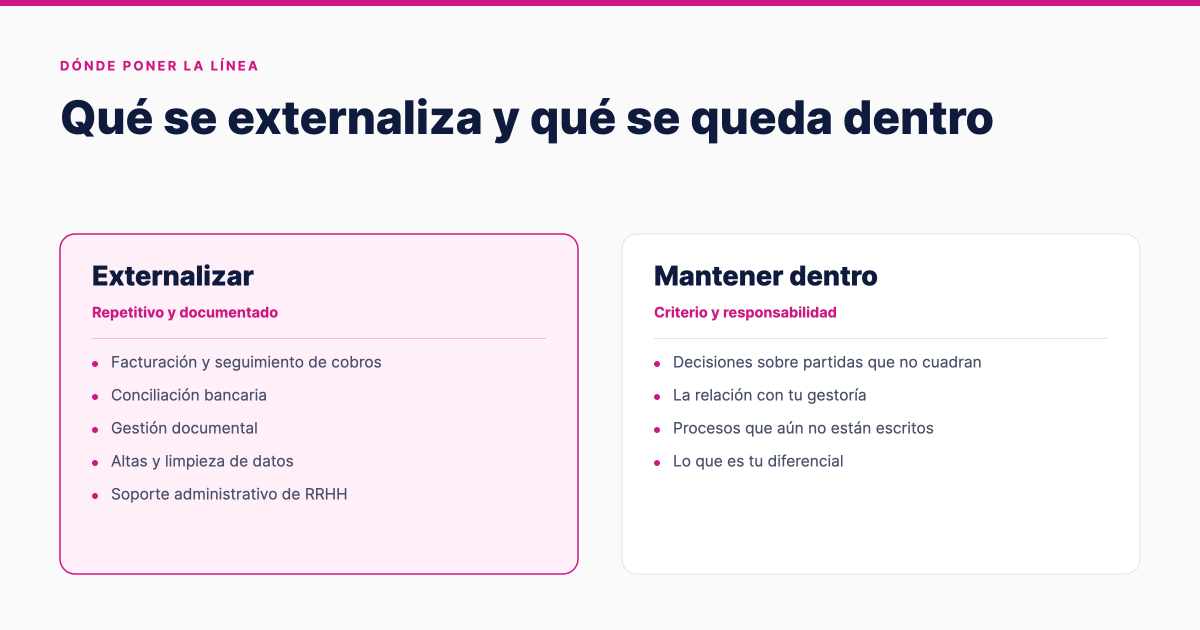
What processes can an SME outsource?
The rule of thumb is simple: if the process is repetitive, has a verifiable outcome, and doesn’t require business judgment on a case-by-case basis, it can be outsourced.
Billing and Invoice Tracking
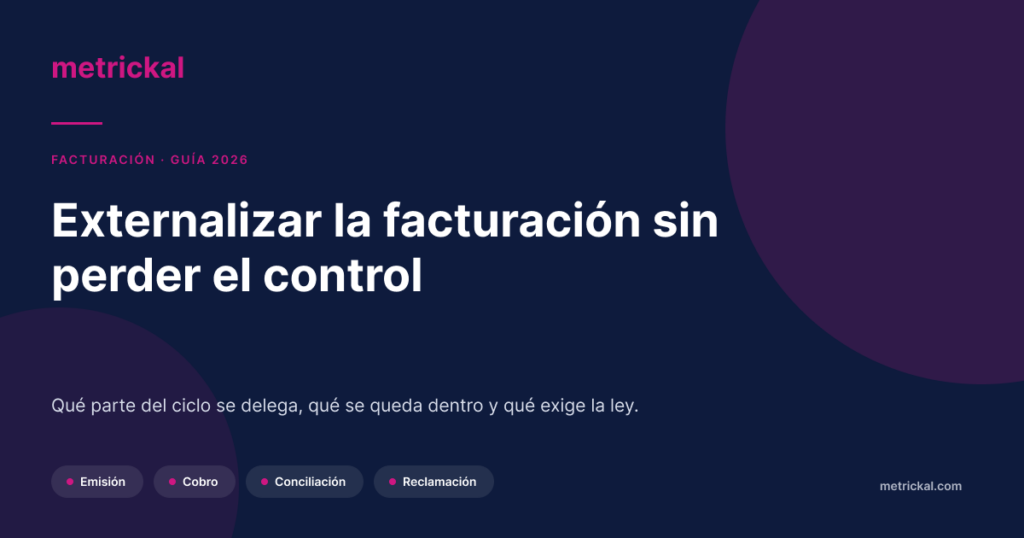
Issuing, sending, recording, and following up. This is the most time-consuming process and the one that gets delayed the most during peak periods, because it always seems like it can wait until tomorrow. We’ve broken down the entire process to show what to delegate when outsourcing invoicing.
Accounting and bank reconciliation
Here, it’s important to distinguish between two things that are often confused. The accounting firm files taxes and is responsible for them. The work of preparing the journal entries and bank reconciliations so the accounting firm can do its job is a separate matter—and it’s the part that usually falls behind. Outsourcing accounting clearly draws the line between the two.
Document Management
Classify contracts, file supporting documents, verify that a delivery slip matches its invoice. High-volume work, clear rules, and measurable errors.
Data Entry and Maintenance
Registering customers and suppliers, correcting duplicates, keeping the CRM clean. No one does this until the reports stop adding up.
Administrative support for human resources
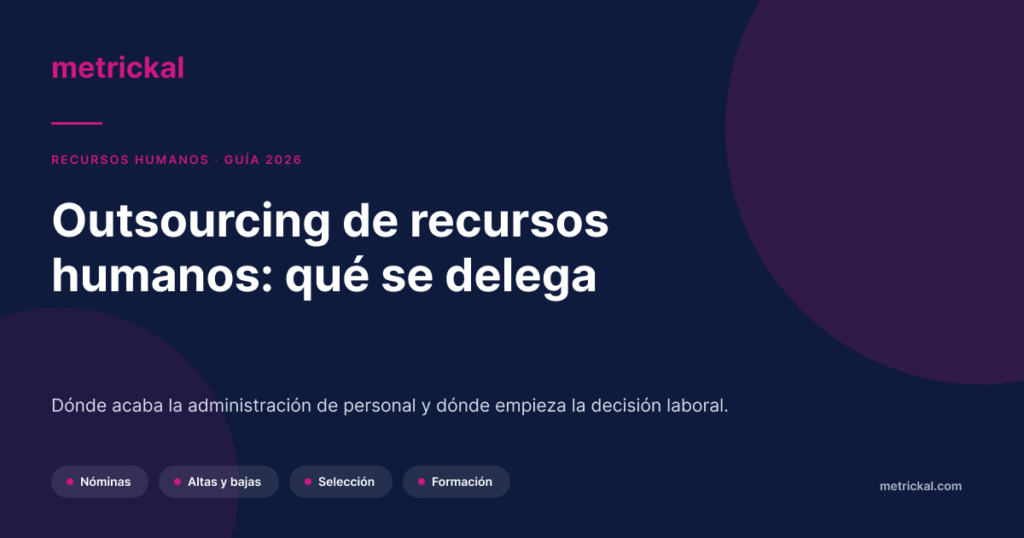
The documentation and record-keeping aspects—not personnel decisions. That distinction matters more than it seems, and we’ll explain what HR tasks can be outsourced and which ones shouldn’t be.
What Should Not Be Outsourced
This is the part that comparison guides tend to skip, and it’s the one that saves you a lot of trouble.
- The decision, not the processing. It’s fine for someone to prepare the reconciliation. But it’s not okay for someone to decide what to do with an entry that doesn’t balance.
- The relationship with the party accountable to the tax authorities. Your accounting firm or tax advisor signs it. That responsibility cannot be outsourced, even if the preparatory work can.
- The processes you haven’t written down yet. A process that exists only in one person’s head can’t be handed off—at best, it can be improvised. First, document it; then, put it into action.
- What sets you apart. If your advantage is responding to a quote within two hours, that process stays in-house.
The two dates that affect the calculation in Spain
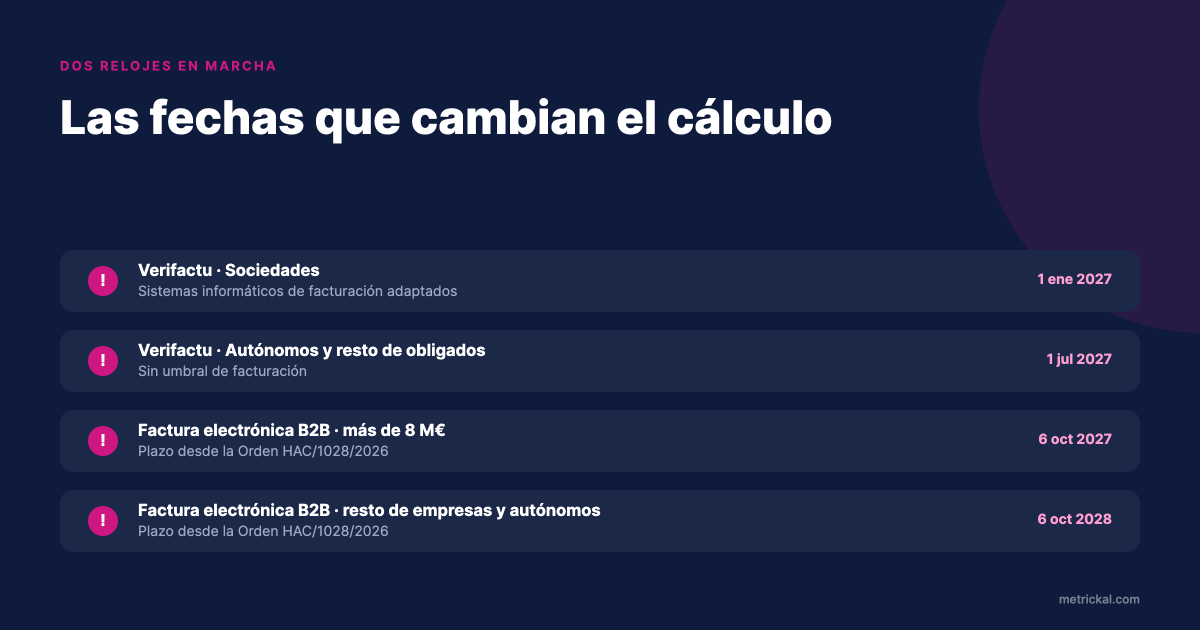
Almost no article on back-office operations mentions this, and it is what will most influence the decisions of any Spanish small or medium-sized business over the next two years. There are two distinct obligations, with two different timelines, and both fall right on top of revenue.
The first is the regulation on computerized invoicing systems, known as Verifactu. Royal Decree-Law 15/2025 extended the deadlines: companies must comply by January 1, 2027, and all other parties subject to the regulation—including self-employed individuals—by July 1, 2027. There is no revenue threshold, so the regulation applies regardless of your company’s size.
The second is business-to-business electronic invoicing under Law 18/2022. For years, it had no implementation date because a ministerial order was missing. It has now been published: Order HAC/1028/2026 took effect on October 6, 2026, and set the clock in motion. From that point on, companies with annual revenue exceeding 8 million have until October 6, 2027, to comply, while all other companies and self-employed individuals have until October 6, 2028.
What this means in practice: if you’re going to outsource billing, the provider has to work with a system that meets the requirements, and switching systems is a project in and of itself. Doing both at the same time—switching tools and handing over control—is the most expensive way to go about it. It’s best to sort out the tool first and then decide who will handle it.
Where to start?
Don’t start with the biggest process. Start with the most tedious one.
Pick the process that takes the most time and requires the least judgment—usually document management or data entry—and handle it on your own. This helps you verify two things before risking anything significant: whether the vendor asks intelligent questions during the handoff and whether errors go up or down in the first month. If that pilot project goes well, the next one can be billing.
Here’s how we work: We’re a Barcelona-based BPO company with account managers in Spain and teams in the countries that best match the job profile, spread across 10 countries and three continents—typically the Philippines and Colombia. This is the same model we use to provide services to Flipdish and Doctoralia.
Frequently Asked Questions
What back-office processes can an SME outsource?
Those that are repetitive, have a verifiable outcome, and do not require case-by-case business judgment. In practice, there are five categories: billing and collections, reconciliation, document management, data entry, and administrative support for human resources. The deciding factor isn’t the importance of the process, but whether it’s documented.
Do you lose control when you outsource back-office operations?
It’s lost if the only place where the process takes place is the vendor’s tool. It’s maintained if the data remains on your systems, you have read access to what generates the reports, and the service level is documented with its timeline.
Does this replace my accounting firm?
No, and it’s best not to confuse the two. The accounting firm files documents with and is accountable to the government. The outsourced back office prepares the work the accounting firm needs—which is precisely the part that tends to fall behind in an SME.
How does Verifactu affect the outsourcing of invoicing?
It requires that the system used to issue your invoices comply with the regulations by January 1, 2027, if you are a corporation, and by July 1, 2027, in all other cases. Before transitioning to the new process, it’s best to decide which tool you’ll use, because switching both systems and equipment at the same time increases the likelihood of errors.
When does electronic invoicing become mandatory between businesses?
The deadline began on October 6, 2026, when Order HAC/1028/2026 took effect. For those with annual revenue exceeding 8 million, the deadline is October 6, 2027, and for all other businesses and self-employed individuals, it is October 6, 2028.
How many hours are saved by outsourcing?
It depends on the volume, and any percentage they give you without seeing your processes is just a made-up number. The only measure that really works is this one: track the hours you spend on those processes for two weeks and compare them to the third month, once the transition is fully established.
How to decide without overthinking it
Make a list of the administrative processes and organize them into two columns: how many hours per month they take and whether they’re documented anywhere. Anything that takes a lot of hours and is documented can be outsourced right away. Anything that takes a lot of hours and isn’t documented is a sign of where your company’s real risk lies—and that’s fixed by documenting it, whether you outsource it or not.
If you’d like us to review your list and the associated workloads, let’s talk.
Regulatory References: Royal Decree 1007/2023 and Royal Decree-Law 15/2025, dated December 2 (Official State Gazette [BOE] of December 3, 2025), regarding computerized invoicing systems. Law 18/2022, Royal Decree 238/2026, and Order HAC/1028/2026, dated October 2 (Official State Gazette [BOE] No. 247, October 5, 2026), regarding electronic invoicing between businesses.