
When scaling operations without expanding our workforce, we must choose between nearshore and offshore outsourcing.Nearshore teams offer time zone alignment and cultural compatibility, enabling smoother collaboration.
Offshore teams provide access to larger talent pools and lower costs but may require more management. Understanding these differences helps us optimize productivity, control costs, and maintain quality.
This article explores the advantages, challenges, and cost comparisons of both models to help us select the best outsourcing strategy for our business needs.
Key Insights: Nearshore Outsourcing vs Offshoring
Before exploring the details, here are three crucial points to guide our decision between nearshore and offshore outsourcing:
- Time Zone and Cultural Fit Matter – Nearshore teams provide real-time collaboration and smoother communication due to geographic and cultural alignment.
- Cost vs Talent Trade-offs – Offshoring can lower labor costs substantially but may require more oversight and rely on asynchronous workflows.
- Operational Efficiency and Risk Management – We must evaluate IP protection, regulatory compliance, and project management needs when choosing the right outsourcing model.
Understanding Nearshore Outsourcing and Offshoring
We often confuse nearshore outsourcing with offshoring, but the differences are clear when we examine geography, communication, and operational needs.
Definition of Nearshore Outsourcing
Nearshore outsourcing involves hiring teams in nearby countries, usually within the same or similar time zones, which facilitates real-time communication and smoother project management.
According to HatchWorks AI, the tech sector in common nearshore hubs like Costa Rica is projected to grow by over 55% through 2028, highlighting a surge in regional talent availability.
As HatchWorks AI reports, “This growth signals increased access to skilled professionals, enabling faster project delivery and improved collaboration.”
Key aspects include:
- Geographic proximity for travel convenience
- Time zone alignment for real-time collaboration
- Cultural and linguistic compatibility to reduce communication barriers
Definition of Offshoring
Offshoring involves hiring teams in distant countries, often across continents. The primary benefit is access to larger talent pools and significant labor cost savings. Common offshore regions include Asia-Pacific and Eastern Europe.
While cost savings can be substantial, offshoring usually involves:
- Significant time zone differences leading to asynchronous workflows
- Potential cultural misalignment impacting collaboration
- Increased project management and communication overhead
Key Differences at a Glance
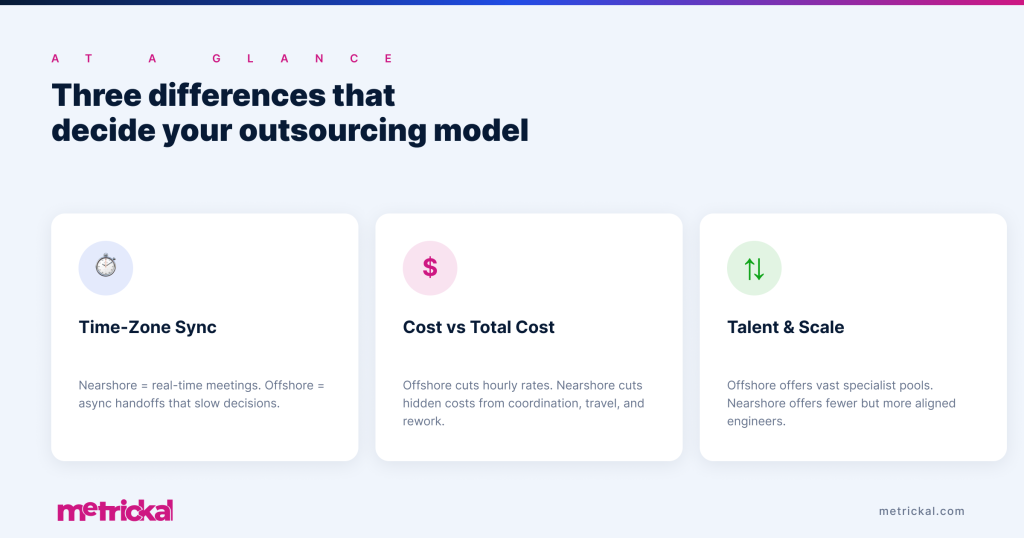
Understanding the major differences helps us decide which model suits our needs. Key contrasts include:
- Time Zone Alignment: Nearshore allows synchronous work; offshore often requires asynchronous communication.
- Communication Barriers: Cultural and language compatibility is stronger with nearshore teams.
- Travel Logistics: Shorter distances for nearshore make site visits feasible.
- Labor Costs: Offshore teams generally cost less, but hidden costs may offset savings.
Advantages and Challenges of Nearshore Outsourcing
Nearshore outsourcing provides benefits for teams that need smooth collaboration and quick project ramp-up. However, it is not without challenges.
Advantages
Nearshore outsourcing offers several operational benefits, particularly for businesses focused on efficiency and real-time collaboration.
Key advantages include:
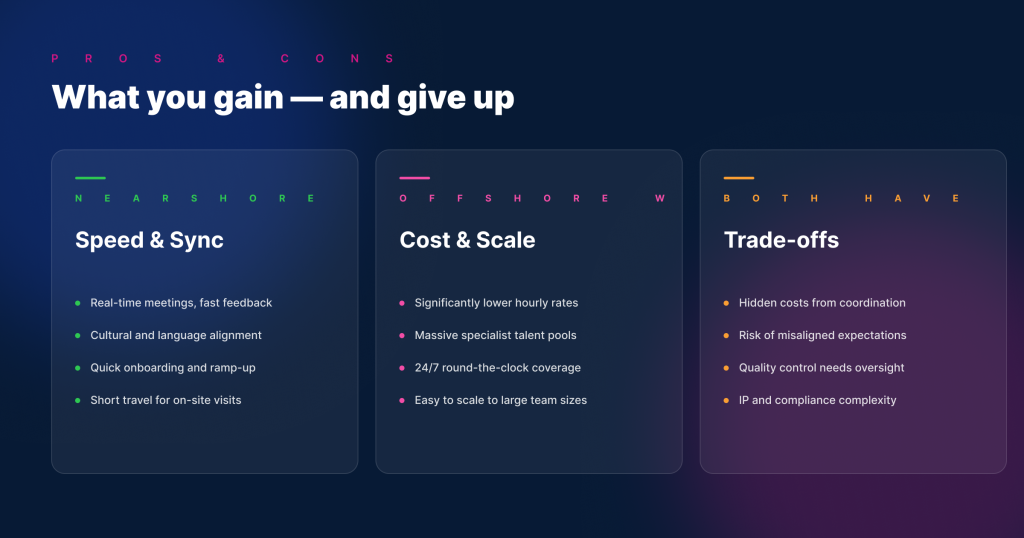
- Real-Time Collaboration: Teams in similar time zones allow us to meet, discuss, and resolve issues quickly.
- Cultural and Linguistic Compatibility: Shared norms and English proficiency reduce misunderstandings and errors.
- Lower Travel Costs: Short distances make on-site visits feasible without significant expense.
- Quicker Ramp-Up: Knowledge transfer and onboarding are faster, supporting faster project delivery.
Challenges
Despite its benefits, nearshore outsourcing has limitations we should consider:
- Higher Labor Costs: Compared to offshore alternatives, nearshore salaries can be higher.
- Smaller Talent Pool: Specialized skills may be less abundant than in global offshore regions.
- Limited Scalability: Large-scale projects may face constraints due to the size of the local talent pool.
- Market Maturity: Some regions may have regulatory or compliance limitations impacting project scope.
Advantages and Challenges of Offshoring
Offshoring can be cost-effective and scalable but introduces operational challenges that require careful planning.
Advantages
Offshoring is attractive for businesses looking to maximize cost savings and access specialized talent.
Main advantages include:
- Significant Cost Savings: Labor rates are lower in regions like Asia-Pacific and Eastern Europe.
- Large Talent Pool: We can access diverse skill sets for software development, customer support, and back-office operations.
- Scalability: Offshore teams allow flexible scaling with staff augmentation or dedicated teams.
- 24/7 Operations: Time zone differences can support round-the-clock workflows for continuous service delivery.
Challenges
Offshoring requires attention to operational efficiency and risk mitigation.
Common challenges include:
- Communication Barriers: Time zone differences can delay responses and increase project complexity.
- Cultural Misalignment: Misunderstandings in workflow expectations can reduce productivity.
- Project Management Overhead: Remote monitoring and coordination require additional effort.
- IP Protection and Data Security Risks: Distance and legal differences can complicate compliance and intellectual property protection.
Cost Comparison: Nearshore vs Offshore
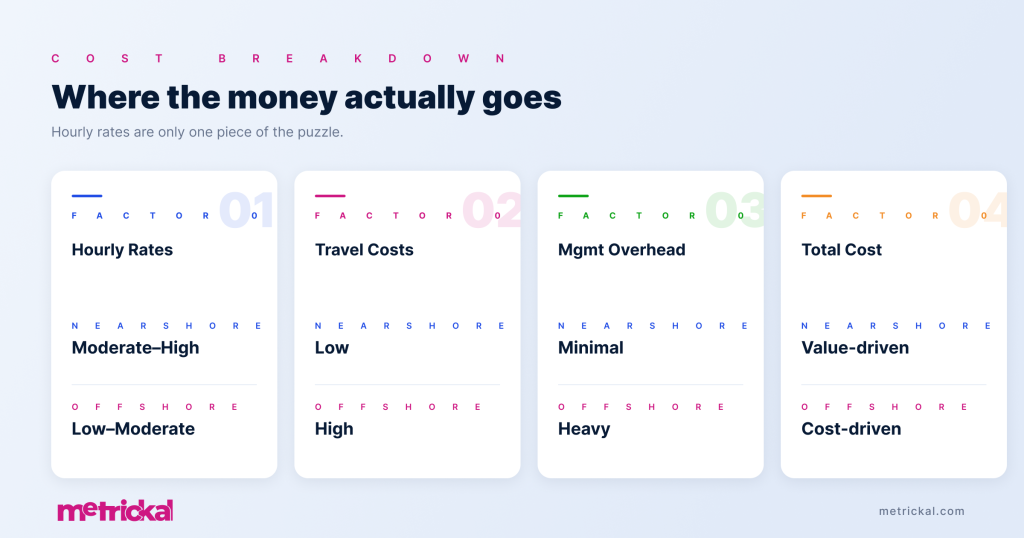
Offshore outsourcing is often perceived as the lowest-cost option, but actual expenses depend heavily on management overhead, project complexity, and operational efficiency.
As noted by IQ BackOffice, companies adopting modern, full-service outsourcing models in 2026 typically achieve significant savings by focusing on integration rather than hourly rates alone.
As IQ BackOffice reports, “Organizations prioritizing integrated workflows report a 25% to 40% reduction in total operational costs, highlighting the importance of calculating Total Cost of Ownership.”
Here’s a cost comparison for clarity:
| Cost Factor | Nearshore Outsourcing | Offshore Outsourcing |
| Hourly Rates | Moderate to High | Low to Moderate |
| Travel Expenses | Low (Short distance) | High (Long distance) |
| Management Overhead | Minimal (Real-time) | High (Coordination heavy) |
| Communication Costs | Low (Sync workflows) | Moderate (Async tools) |
| Total Cost of Ownership | Value-driven / Balanced | Efficiency-driven / Low-cost |
Factors to consider when evaluating these costs include:
- Average hourly rates by region
- Costs of delayed feedback and asynchronous workflows
- Total cost of ownership including project management and travel
Performance and Productivity Considerations
Both nearshore and offshore models affect project performance differently.
Quality Control and Innovation Speed
We often see nearshore teams deliver faster innovation due to closer collaboration and cultural alignment. Offshore teams, with larger talent pools, excel in scaling complex projects but may require additional oversight for quality control.
Key factors:
- Turnover rates and knowledge continuity
- Real-time vs asynchronous collaboration
- Agile methodologies for structured workflows
Workflow Efficiency
We must evaluate workflow efficiency in terms of communication methods and project management style.
Factors include:
- Synchronous vs asynchronous communication efficiency
- Hybrid models combining nearshore and offshore teams
- Knowledge transfer and iterative feedback loops to improve outcomes
Risk Management and Compliance
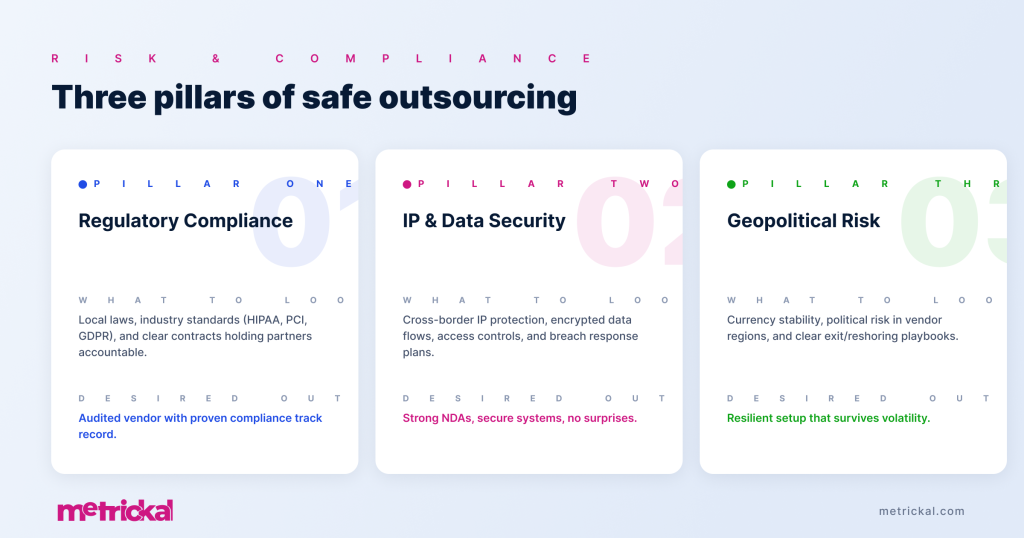
Outsourcing involves regulatory, economic, and operational risks that we must manage proactively.
Regulatory Compliance and Industry Standards
Compliance is essential in industries like healthcare, fintech, and e-commerce.
We need to consider:
- Local regulations in outsourcing destinations
- IP protection and data security measures
- Contract negotiation and vendor selection for accountability
Economic and Geopolitical Risks
Economic stability and geopolitical factors influence long-term outsourcing decisions.
Points to evaluate:
- Political risks and currency fluctuations
- Reshoring alternatives for critical operations
- Exit strategies in case of sudden market changes
Choosing Between Nearshore and Offshore
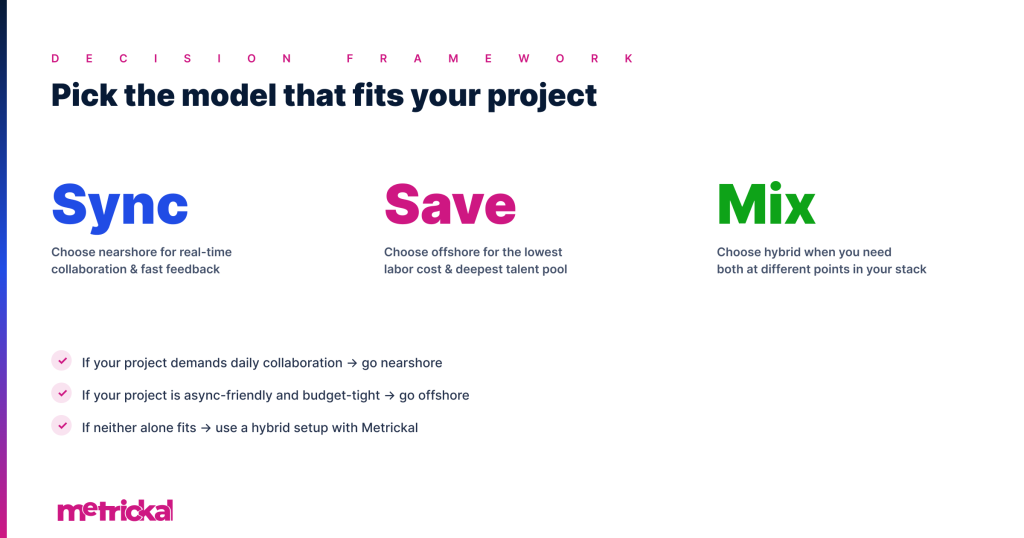
Making the right choice requires aligning outsourcing strategy with our business goals and operational priorities.
Decision Factors
We should consider multiple elements to ensure successful outcomes.
Factors include:
- Project complexity and skill requirements
- Time-sensitive vs cost-sensitive priorities
- Alignment with client expectations and strategic goals
Hybrid and Scalable Models
Hybrid models combine the benefits of nearshore and offshore teams, offering flexibility for complex projects.
We can leverage:
- Dedicated teams for ongoing work
- Staff augmentation for temporary skill needs
- Scalable solutions tailored to our business growth trajectory
FAQ
What is the difference between nearshore outsourcing and offshoring?
Nearshore outsourcing hires teams in nearby countries, offering better time zone alignment, real-time collaboration, and cultural compatibility. Offshoring hires teams in distant countries, providing larger talent pools and lower labor costs, but may require asynchronous communication and more project management oversight.
Which is more cost-effective: nearshore or offshore outsourcing?
Offshoring usually offers lower hourly rates and labor costs. Nearshore may cost more but reduces hidden costs, rework, and delays due to smoother collaboration and time zone alignment, often improving overall efficiency.
How does time zone affect outsourcing efficiency?
Time zone alignment allows nearshore teams to communicate in real-time, resolve issues quickly, and meet deadlines efficiently. Offshore teams may require asynchronous workflows, slowing decision-making and needing more project management.
What are the main risks of offshoring?
Offshoring risks include delayed communication, cultural differences, regulatory compliance challenges, IP protection concerns, and higher management overhead. These risks require careful planning, monitoring, and clear processes to mitigate.
When should we choose nearshore outsourcing?
Nearshore outsourcing is ideal when projects require synchronized workflows, faster ramp-up, cultural alignment, real-time collaboration, and reduced delays. It suits businesses prioritizing operational efficiency and project quality.
Nearshore Outsourcing vs Offshoring: Final Considerations
Choosing between nearshore outsourcing and offshoring involves trade-offs. Nearshore works best for real-time collaboration, cultural alignment, and smooth communication. Offshore suits cost-sensitive projects, specialized skills, and large-scale team expansion.
At Metrickal, we help businesses navigate these decisions by offering tailored solutions that balance efficiency, cost, and operational risk.
Whether using nearshore teams for synchronized workflows or offshore teams for scaling projects, we ensure alignment with our goals and project expectations, enabling optimized productivity and effective outsourcing strategies.
Learn more about how we optimize outsourcing strategies and scale your operations efficiently by visiting Metrickal.
References
- https://hatchworks.com/blog/nearshore-development/nearshore-vs-offshore-outsourcing/
- https://www.iqbackoffice.com/outsourcing-accounting-in-2026-trends-growth-drivers-and-what-every-cfo-needs-to-know/